Student Loan Repayment 2026: Save Over $5,000 on Interest

Navigating the complex world of student loan repayment can feel like an insurmountable challenge, especially with the ever-evolving financial landscape. As we approach 2026, understanding the nuances of your student debt and implementing strategic repayment methods is more critical than ever. The good news? With the right knowledge and proactive planning, you can significantly reduce your financial burden. This comprehensive guide will equip you with insider knowledge and actionable strategies to save over $5,000 on interest and effectively manage your student loan repayment.
Student loans represent a significant financial commitment for millions. For many, the sheer size of the debt, coupled with interest accrual, can seem overwhelming. However, by taking a proactive approach and understanding the various repayment options available, you can transform your financial outlook. Our goal is to demystify the process, highlight key opportunities, and provide you with a roadmap to financial freedom from student debt.
The journey to saving thousands on interest begins with a clear understanding of your current student loan repayment situation. This includes knowing your loan types (federal vs. private), interest rates, principal balances, and current repayment plan. Without this foundational knowledge, it’s impossible to tailor an effective strategy.
Understanding Your Student Loan Landscape in 2026
Before diving into specific strategies, it’s crucial to grasp the current state of your student loan portfolio. This involves gathering essential information and understanding the terminology. Whether you’re just starting your student loan repayment journey or have been paying for years, a thorough assessment is the first step towards optimizing your payments.
Federal vs. Private Loans: Why It Matters for Student Loan Repayment
The distinction between federal and private student loans is paramount. Federal loans often come with more flexible repayment options, income-driven repayment plans, and potential forgiveness programs. Private loans, on the other hand, typically offer fewer protections but may have competitive interest rates depending on your creditworthiness. Knowing which type of loan you have will dictate the strategies available to you for student loan repayment.
- Federal Loans: These are typically disbursed by the U.S. Department of Education. They often include benefits like income-driven repayment (IDR) plans, deferment, forbearance, and potential Public Service Loan Forgiveness (PSLF). Examples include Stafford Loans, Perkins Loans, and PLUS Loans.
- Private Loans: Issued by banks, credit unions, and other private lenders. These loans generally have fewer consumer protections and repayment flexibilities. Their terms are often based on the borrower’s credit score and can have variable or fixed interest rates.
Interest Rates and Principal Balances: The Core of Your Debt
Your interest rate is the cost of borrowing money, expressed as a percentage of the principal. The higher the interest rate, the more you’ll pay over the life of the loan. Your principal balance is the original amount borrowed, minus any payments already made. Understanding how interest accrues on your principal is vital for effective student loan repayment.
- Fixed vs. Variable Interest Rates: Fixed rates remain constant throughout the loan term, providing predictability. Variable rates can fluctuate based on market conditions, potentially leading to higher or lower monthly payments.
- Accrued Interest: Interest that has accumulated on your loan but has not yet been paid. This can capitalize (be added to your principal balance) under certain circumstances, increasing the amount on which future interest is calculated.
Your Current Repayment Plan: Is It Optimal for Student Loan Repayment?
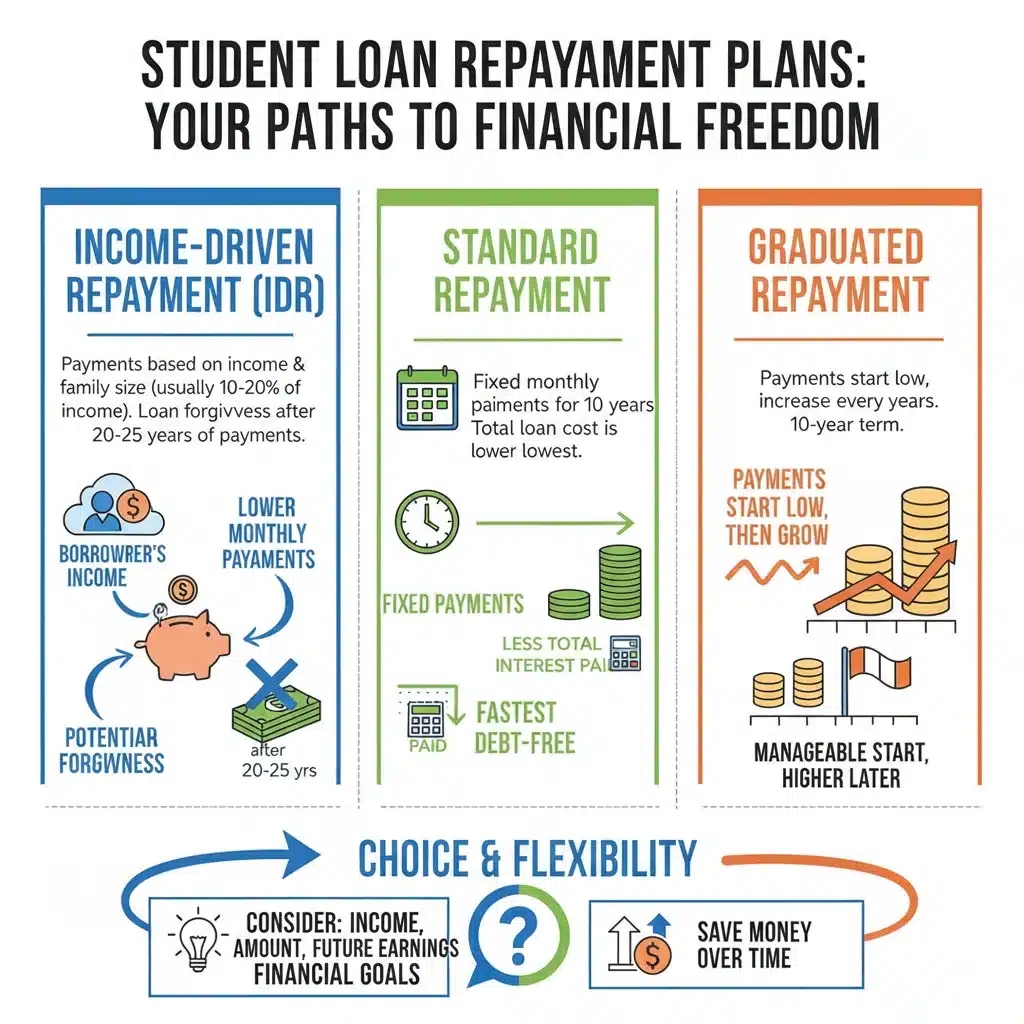
Many borrowers simply stick with the default repayment plan, unaware that other options could save them significant money. Reviewing your current plan – whether it’s the Standard, Graduated, Extended, or an Income-Driven Repayment (IDR) plan – is a critical step in optimizing your student loan repayment strategy.
Strategic Student Loan Repayment Plans to Save Over $5,000
Once you have a clear picture of your loans, it’s time to explore the various repayment strategies designed to minimize interest and accelerate your path to debt freedom. The goal is to identify the plan that best fits your financial situation and long-term objectives for student loan repayment.
Income-Driven Repayment (IDR) Plans: A Lifeline for Federal Loans
For federal student loan borrowers, Income-Driven Repayment (IDR) plans can be a game-changer. These plans adjust your monthly payment based on your income and family size, making payments more affordable. After a certain period (20 or 25 years, depending on the plan), any remaining balance may be forgiven, though this forgiven amount is typically taxable as income.
- REPAYE (Revised Pay As You Earn): Generally caps payments at 10% of discretionary income.
- PAYE (Pay As You Earn): Also caps payments at 10% of discretionary income, but with stricter eligibility requirements.
- IBR (Income-Based Repayment): Payments are typically 10% or 15% of discretionary income, depending on when you took out your loans.
- ICR (Income-Contingent Repayment): Payments are either 20% of discretionary income or what you’d pay on a fixed 12-year plan, whichever is less.
While IDR plans can lower your monthly payments, they often extend the repayment period, potentially increasing the total interest paid over time. However, for those with high debt-to-income ratios, they can prevent default and offer a path to eventual forgiveness. The key is to run the numbers and see if the reduced monthly burden and potential forgiveness outweigh the increased interest over the life of the loan. This is a crucial aspect of informed student loan repayment.
The Power of the Standard Repayment Plan: When to Use It
The Standard Repayment Plan is the default for most federal loans, designed to pay off your loan in 10 years with fixed monthly payments. While it may result in higher monthly payments than IDR plans, it often leads to the least amount of interest paid over the life of the loan. If you can afford the payments, this plan is highly recommended for efficient student loan repayment.
Aggressive Repayment Strategies: Beyond the Minimum
To truly save over $5,000 on interest, you’ll likely need to go beyond the minimum required payments. These aggressive strategies can significantly reduce your principal faster, thereby cutting down the total interest accrued.
- Making Extra Payments: Even small additional payments can make a big difference. Directing extra funds specifically towards your principal can shave years off your repayment timeline and thousands off your interest.
- The Debt Avalanche Method: This strategy involves paying the minimum on all your loans except for the one with the highest interest rate. You throw all extra money at that high-interest loan until it’s paid off, then move to the next highest. This method is mathematically proven to save you the most money on interest for student loan repayment.
- The Debt Snowball Method: While not as mathematically efficient for interest savings, the snowball method provides psychological wins. You pay off your smallest loan first, then roll that payment into the next smallest, gaining momentum. This can be highly motivating for some borrowers.
- Bi-Weekly Payments: By making half-payments every two weeks, you end up making one extra full payment per year without feeling a significant pinch in your budget. This seemingly small change can dramatically reduce your interest and repayment period.
Refinancing and Consolidation: Insider Knowledge for Student Loan Repayment
Refinancing and consolidation are powerful tools, but they come with important considerations. Understanding when and how to use them can unlock significant interest savings.
Student Loan Refinancing: A Game-Changer for Lower Interest
Refinancing involves taking out a new loan from a private lender to pay off your existing student loans. The primary goal is to secure a lower interest rate, which can save you thousands over the life of the loan. This is especially beneficial if your credit score has improved significantly since you first took out your loans or if current market interest rates are lower.
Key Considerations for Refinancing:
- Loss of Federal Loan Benefits: Refinancing federal loans into a private loan means forfeiting crucial protections like IDR plans, deferment, forbearance, and potential forgiveness programs. This is the biggest drawback and should be carefully weighed.
- Credit Score Impact: Lenders will assess your creditworthiness, income, and debt-to-income ratio. A strong credit score is essential to qualify for the best rates.
- Shop Around: Don’t settle for the first offer. Compare rates and terms from multiple lenders to find the most competitive option.
- Fixed vs. Variable Rates: Decide whether a predictable fixed rate or a potentially lower but fluctuating variable rate is right for you.
For those with private loans, refinancing is often a no-brainer if you can secure a lower rate. For federal loan borrowers, it requires a careful cost-benefit analysis. Could you save more than $5,000 on interest by refinancing, even if it means giving up federal protections? This is a question only you can answer after thoroughly evaluating your financial situation and risk tolerance for student loan repayment.
Student Loan Consolidation: Simplifying Federal Loan Repayment
Federal student loan consolidation combines multiple federal loans into a single new federal loan with a weighted average interest rate. While it doesn’t typically lower your interest rate, it can simplify your student loan repayment by providing a single monthly payment and can open doors to certain IDR plans or Public Service Loan Forgiveness (PSLF) that might not have been available with your original loans.
Benefits of Consolidation:
- Streamlined Payments: One servicer, one payment, making your student loan repayment easier to manage.
- Access to IDR Plans: Some older federal loan types may not be eligible for all IDR plans until they are consolidated.
- PSLF Eligibility: Consolidation is often a prerequisite for PSLF for certain loan types.
It’s important to note that federal consolidation is different from private refinancing. Federal consolidation keeps your federal loan benefits, while private refinancing converts federal loans into private ones, losing those benefits.
Leveraging Financial Tools and Resources for Student Loan Repayment
In 2026, a plethora of financial tools and resources are available to help you manage your student loan repayment more effectively. From budgeting apps to professional financial advice, these can provide the support and insights needed to save thousands.
Budgeting and Expense Tracking: The Foundation of Savings
You can’t save money if you don’t know where it’s going. Implementing a robust budgeting system is fundamental. Tools like Mint, YNAB (You Need A Budget), or even a simple spreadsheet can help you track your income and expenses, identify areas for savings, and free up extra cash to put towards your student loans.
- Create a Detailed Budget: Categorize all your income and expenses.
- Identify ‘Leakage’: Pinpoint areas where you can cut back, even temporarily.
- Automate Savings: Set up automatic transfers to your student loan servicer for extra payments.
Student Loan Calculators and Simulators
Many websites and loan servicers offer calculators that allow you to model different repayment scenarios. You can input various payment amounts, interest rates, and repayment periods to see how they impact your total interest paid and your loan payoff date. This is an invaluable tool for visualizing the impact of aggressive student loan repayment strategies.
Professional Financial Advice: A Worthwhile Investment
For complex situations, or if you’re feeling overwhelmed, consulting a fee-only financial advisor specializing in student debt can be incredibly beneficial. They can help you analyze your specific situation, navigate repayment options, and create a personalized strategy for student loan repayment to save over $5,000.
Insider Knowledge: Advanced Tips for Student Loan Repayment in 2026
Beyond the standard advice, certain ‘insider’ tips can give you an edge in your student loan repayment journey.
Understanding the Tax Implications of Student Loan Repayment
- Student Loan Interest Deduction: You may be able to deduct up to $2,500 in student loan interest paid each year, reducing your taxable income. This can be a valuable saving.
- Taxable Forgiveness: While IDR plan forgiveness can be a relief, be aware that the forgiven amount is often treated as taxable income by the IRS, unless it’s PSLF. Plan accordingly for this potential tax bomb.
The Power of Employer Benefits
Some employers are increasingly offering student loan repayment assistance as a benefit. Inquire with your HR department to see if your company provides any form of assistance, such as direct contributions to your loan principal or matching programs. This can significantly accelerate your student loan repayment.
Refinancing Again (and Again)
Refinancing isn’t a one-time event. If interest rates drop further, or if your credit score improves even more, you might be able to refinance your private loans again to secure an even lower rate. Continuously monitoring market conditions for your student loan repayment can yield substantial savings.
Public Service Loan Forgiveness (PSLF): A Niche but Powerful Option
For those working in qualifying public service jobs (government, non-profit organizations), PSLF offers forgiveness of the remaining federal loan balance after 120 qualifying monthly payments (10 years) under an IDR plan. This can lead to substantial savings, often far exceeding $5,000, but requires careful adherence to specific program requirements for your student loan repayment.
- Qualifying Employer: Must be a government organization (federal, state, local, tribal) or a not-for-profit organization that is tax-exempt under Section 501(c)(3) of the Internal Revenue Code.
- Loan Type: Only Direct Loans are eligible. Other federal loans may need to be consolidated into a Direct Loan.
- Repayment Plan: Must be on an income-driven repayment plan.
- Full-Time Employment: Generally requires full-time employment with a qualifying employer.

Monitoring and Adjusting Your Student Loan Repayment Strategy
Your financial situation isn’t static, and neither should your student loan repayment strategy be. Regularly monitoring your progress and being willing to adjust your plan is key to long-term success and maximizing your savings.
Annual Review of Your Loans and Financial Situation
Set aside time once a year to review your entire financial picture. This includes:
- Checking Interest Rates: Are current refinancing rates lower than what you’re currently paying?
- Income Changes: Has your income increased or decreased? This could impact your eligibility for certain IDR plans or your ability to make extra payments for student loan repayment.
- Credit Score: Has your credit score improved, potentially qualifying you for better refinancing terms?
- Life Events: Marriage, having children, or other significant life changes can impact your financial obligations and eligibility for certain loan benefits.
Staying Informed About Policy Changes
Student loan policies, especially for federal loans, can change. Stay informed about any new legislation, relief programs, or adjustments to existing repayment plans. Reliable sources include the U.S. Department of Education website, reputable financial news outlets, and student loan advocacy groups. Being aware of these changes can open new avenues for saving on your student loan repayment.
Don’t Be Afraid to Contact Your Servicer
Your loan servicer is there to help you navigate your options. If you’re struggling to make payments, facing a financial hardship, or simply want to explore different repayment plans, reach out to them. They can provide information on deferment, forbearance, and various repayment plan enrollment processes. Proactive communication can prevent serious issues and keep your student loan repayment on track.
The Long-Term Impact of Saving Over $5,000 on Interest
Saving $5,000 or more on student loan interest is not just about the immediate financial relief; it has significant long-term implications for your overall financial health. This saved money can be redirected towards other crucial financial goals.
- Increased Savings: The money you save on interest can be channeled into an emergency fund, a down payment for a house, or retirement savings.
- Faster Debt Freedom: By reducing your interest burden, you accelerate your journey to being debt-free, freeing up your income for investments and wealth building.
- Improved Credit Score: Successfully managing and paying down your student loans positively impacts your credit score, making it easier to secure other loans (like mortgages or car loans) at favorable rates in the future.
- Reduced Financial Stress: The psychological benefit of reducing your student loan burden cannot be overstated. Less debt means less stress and greater financial peace of mind.
By 2026, with diligent application of these strategies, you can not only save over $5,000 on interest but also establish a robust foundation for your financial future. Student loan repayment doesn’t have to be a lifelong burden; it can be a manageable challenge with a clear path to resolution.
Conclusion: Your Path to Optimized Student Loan Repayment in 2026
Successfully navigating student loan repayment in 2026 requires a blend of knowledge, strategy, and consistent effort. By understanding your loan types, exploring available repayment plans, considering refinancing, and leveraging financial tools, you can significantly reduce the total cost of your education. The goal of saving over $5,000 on interest is not just an aspiration; it’s an achievable target with the right approach.
Start today by gathering your loan information, assessing your current financial situation, and identifying which of these strategies resonate most with your goals. Remember, every extra dollar you put towards your principal, every percentage point you shave off your interest rate, and every informed decision you make contributes to a brighter, debt-free future. Take control of your student loan repayment journey and unlock substantial financial savings.