Roth vs. Traditional IRA 2026: Maximizing Retirement Savings
Roth vs. Traditional IRA 2026: Maximizing Retirement Savings
Planning for retirement is one of the most crucial financial decisions an individual will make. As we look ahead to 2026, understanding the nuances between a Roth IRA and a Traditional IRA becomes even more vital. Both offer significant tax advantages, but their benefits manifest at different stages of your financial journey. The choice between them can dramatically impact your long-term wealth accumulation and your tax burden in retirement. This comprehensive guide will delve into the intricacies of each account, analyzing their tax implications, contribution limits, eligibility requirements, and withdrawal rules, all with a forward-looking perspective on the 2026 tax landscape. Our goal is to equip you with the knowledge needed to make an informed decision that aligns with your personal financial goals and expected future tax situation.
Understanding the Core Differences: Roth vs. Traditional IRA
At their core, the primary distinction between a Roth IRA and a Traditional IRA lies in when you receive your tax break. This fundamental difference dictates much of their functionality and suitability for various individuals. Both account types are designed to encourage saving for retirement by offering tax incentives, but the timing of these incentives is critical.
Traditional IRA: Tax Deduction Now, Taxes Later
A Traditional IRA is often favored by those who anticipate being in a lower tax bracket during retirement than they are in their working years. Contributions to a Traditional IRA are often tax-deductible in the year they are made. This means that you can reduce your taxable income in the present, potentially leading to a lower tax bill today. The money within the account then grows tax-deferred, meaning you don’t pay taxes on any investment gains until you withdraw the funds in retirement. This deferral of taxes allows your investments to compound more effectively over time, as the money that would have gone to taxes remains invested and continues to grow. However, when you do begin to take distributions in retirement, these withdrawals will be taxed as ordinary income. Required Minimum Distributions (RMDs) typically begin at age 73 (as of the SECURE Act 2.0), compelling you to start withdrawing funds whether you need them or not, which can have tax implications.
Roth IRA: Taxes Now, Tax-Free Later
Conversely, a Roth IRA operates on the principle of ‘pay now, save later.’ Contributions to a Roth IRA are made with after-tax dollars, meaning you do not receive an upfront tax deduction. While this might seem less appealing initially, the significant advantage comes in retirement: qualified withdrawals from a Roth IRA are entirely tax-free. This includes both your contributions and all the accumulated earnings. The tax-free nature of Roth IRA withdrawals is particularly attractive for individuals who expect to be in a higher tax bracket in retirement than they are currently, or for those who simply want the certainty of knowing their retirement income will not be subject to future tax rates. Another key benefit of Roth IRAs is that they do not have Required Minimum Distributions for the original owner, offering greater flexibility in how and when you access your retirement savings. This can be particularly useful for estate planning, as the account can be passed on to heirs tax-free.
Contribution Limits and Eligibility for 2026
Understanding the contribution limits and eligibility requirements is paramount when choosing between a Roth and Traditional IRA. These figures are subject to change annually, and while we are looking forward to 2026, we can extrapolate based on current trends and historical adjustments. The IRS typically announces these limits late in the preceding year.
IRA Contribution Limits
For 2024, the IRA contribution limit is $7,000, with an additional catch-up contribution of $1,000 for those aged 50 and over, bringing the total to $8,000. It is highly probable that these limits will increase slightly by 2026 to account for inflation. For instance, a plausible scenario for 2026 could see the standard contribution limit rise to $7,500 or $8,000, with the catch-up contribution also potentially increasing. It is crucial to monitor IRS announcements for the precise figures closer to the 2026 tax year.
Traditional IRA Eligibility and Deductibility
Anyone with earned income can contribute to a Traditional IRA, regardless of their income level. However, the deductibility of these contributions is where it gets complex, especially if you or your spouse are covered by a retirement plan at work (such as a 401(k)).
- If you are not covered by a workplace retirement plan: Your Traditional IRA contributions are fully tax-deductible, regardless of your income.
- If you are covered by a workplace retirement plan: The deductibility of your Traditional IRA contributions is subject to income phase-out ranges. For 2024, if you’re single and covered by a workplace plan, the deduction begins to phase out at a modified adjusted gross income (MAGI) of $77,000 and is eliminated at $87,000. For married couples filing jointly, the phase-out range is $123,000 to $143,000. These ranges are also likely to increase for 2026, but the principle remains the same: higher earners covered by a workplace plan may not be able to deduct their Traditional IRA contributions.
- If you are not covered, but your spouse is: For 2024, if you are not covered by a workplace retirement plan but your spouse is, your ability to deduct Traditional IRA contributions phases out at a MAGI between $230,000 and $240,000 for those filing jointly.
It’s important to note that even if your contributions aren’t deductible, you can still contribute to a Traditional IRA. These non-deductible contributions grow tax-deferred, but the original contributions are not taxed upon withdrawal, only the earnings. This can be a strategy for those who exceed Roth IRA income limits but still want tax-deferred growth.
Roth IRA Eligibility and Income Limits
Unlike Traditional IRAs, Roth IRAs have strict income limitations for direct contributions. For 2024, if your MAGI is too high, you cannot contribute directly to a Roth IRA. The phase-out ranges for direct Roth IRA contributions are significant:
- Single filers: For 2024, the ability to contribute directly to a Roth IRA phases out between a MAGI of $146,000 and $161,000.
- Married filing jointly: For 2024, the phase-out range is between $230,000 and $240,000.
These income thresholds are also expected to increase for 2026 due to inflation adjustments. If your income exceeds these limits, you might still be able to contribute to a Roth IRA indirectly through the ‘backdoor Roth IRA’ strategy, which involves making non-deductible contributions to a Traditional IRA and then converting them to a Roth IRA. This strategy requires careful execution and understanding of the pro-rata rule if you have existing pre-tax IRA balances.
Tax Advantages: When Do You Pay?
The core of the Roth vs. Traditional IRA debate centers on when you prefer to pay taxes: now or later. This decision should be heavily influenced by your current tax bracket, your projected tax bracket in retirement, and your overall financial outlook for 2026 and beyond.
Current vs. Future Tax Brackets
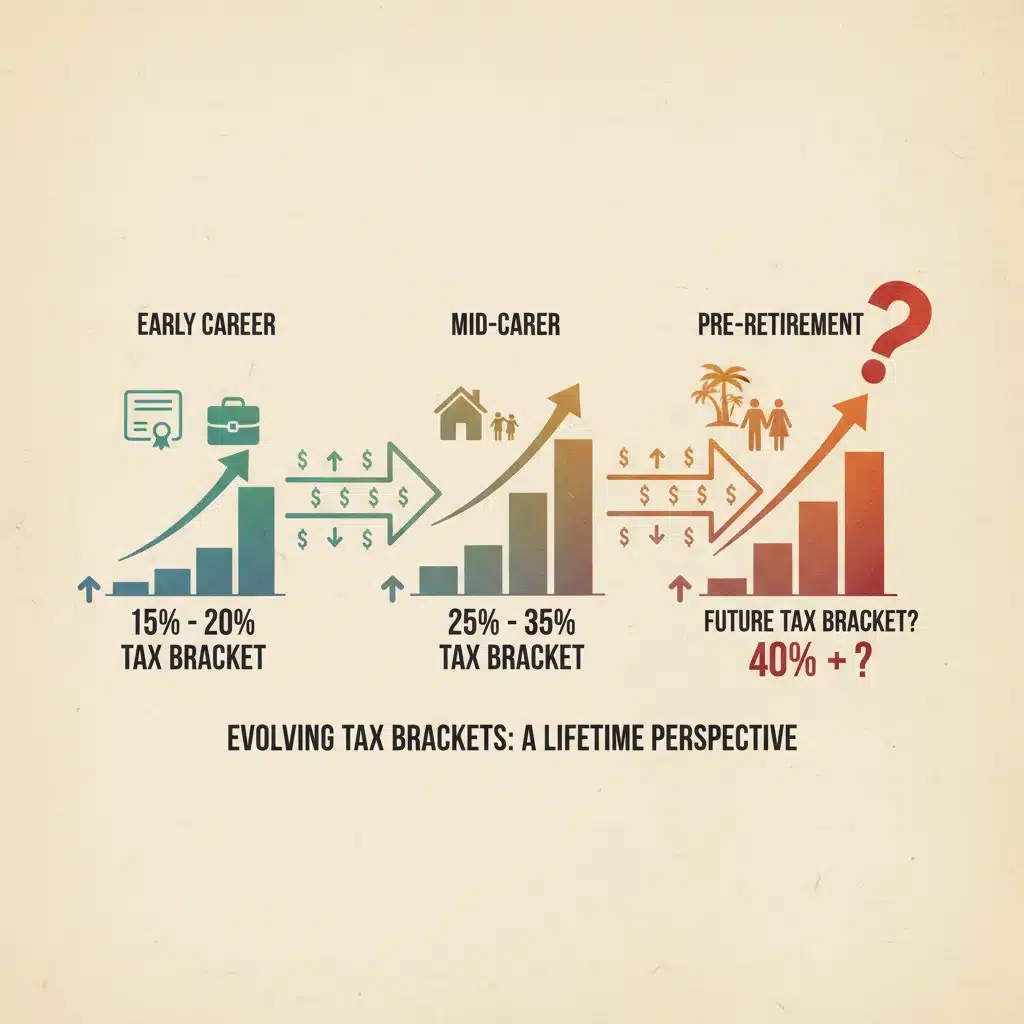
If you anticipate being in a higher tax bracket during your retirement years than you are currently, a Roth IRA is generally the more advantageous choice. By paying taxes on your contributions now, you lock in your current (presumably lower) tax rate, and all future qualified withdrawals, including decades of growth, will be tax-free. This is a powerful benefit, especially considering the potential for tax rates to increase in the future. Conversely, if you are currently in a high tax bracket and expect to be in a lower one during retirement, a Traditional IRA’s upfront tax deduction can be highly beneficial. The immediate tax savings can be invested, further boosting your retirement nest egg.
Tax-Deferred Growth vs. Tax-Free Growth
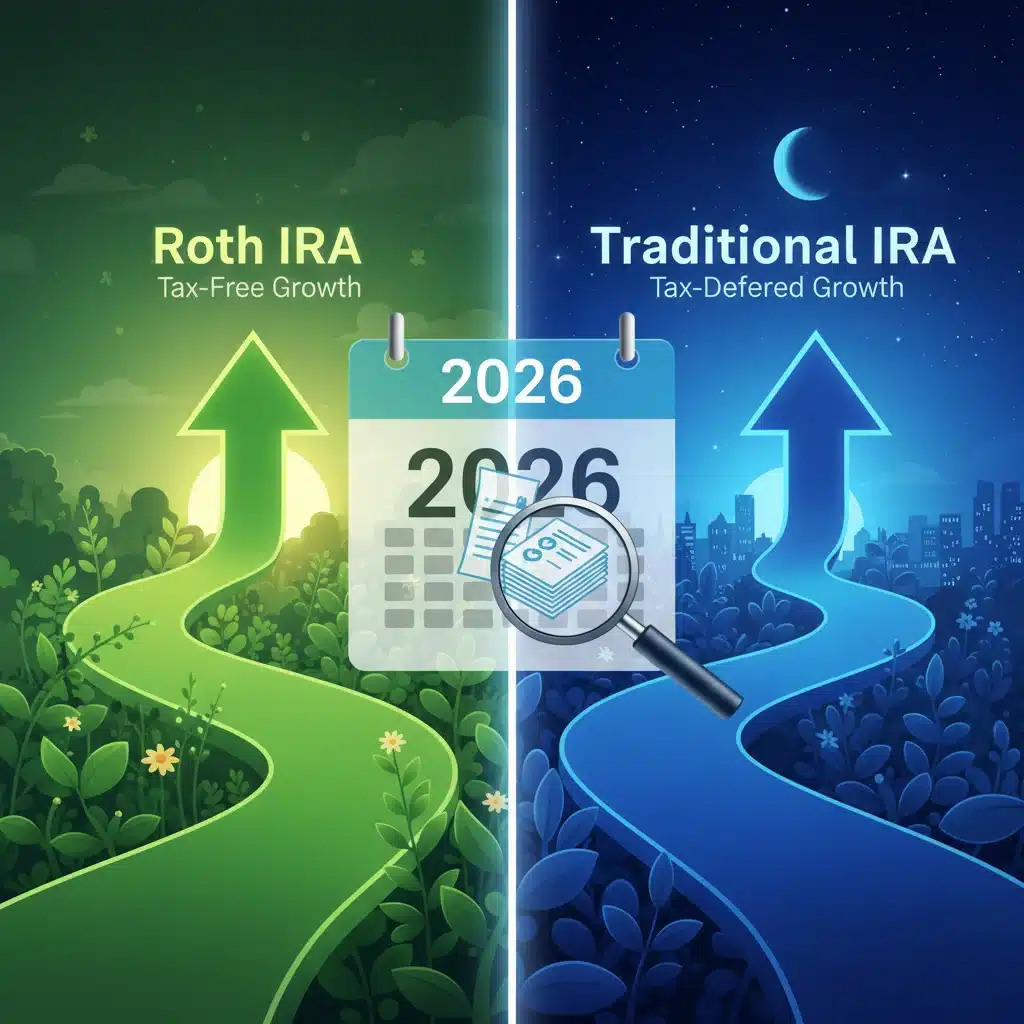
Both accounts offer incredible growth potential, but the tax treatment differs. Traditional IRAs offer tax-deferred growth, meaning your investments grow without being taxed annually. Taxes are only paid when you withdraw the funds in retirement. Roth IRAs, on the other hand, offer tax-free growth. Once contributions are made with after-tax dollars, all qualified earnings and withdrawals are completely tax-free. This distinction is crucial over long periods. Imagine investing $10,000 that doubles every 10 years. In a Traditional IRA, the entire doubled amount is eventually taxed. In a Roth IRA, the entire doubled amount is tax-free. The power of compounding tax-free is immense.
Required Minimum Distributions (RMDs)
RMDs are another key tax-related factor. Traditional IRAs (and most other pre-tax retirement accounts) generally require you to start taking distributions once you reach age 73 (or 75 for those turning 74 after December 31, 2032). These withdrawals are taxed as ordinary income. Roth IRAs, for the original owner, do not have RMDs. This provides incredible flexibility, allowing your money to continue growing tax-free for as long as you wish, or to be passed on to beneficiaries without immediate tax implications. This can be a significant advantage for estate planning or if you have other income sources in retirement and don’t need to tap into your IRA immediately.
Withdrawal Rules and Flexibility
Understanding when and how you can access your money is just as important as how it grows. Both Roth and Traditional IRAs have specific rules regarding withdrawals before and during retirement.
Traditional IRA Withdrawals
Generally, withdrawals from a Traditional IRA before age 59½ are subject to ordinary income tax and a 10% early withdrawal penalty. There are exceptions to this penalty, such as for qualified higher education expenses, first-time home purchases (up to $10,000), unreimbursed medical expenses, and disability. Once you reach age 59½, withdrawals are taxed as ordinary income but are not subject to the 10% penalty. As mentioned, RMDs typically begin at age 73, requiring you to start withdrawing funds.
Roth IRA Withdrawals: The Five-Year Rule and Qualified Distributions
Roth IRA withdrawals are more flexible, but they come with a crucial condition: the ‘five-year rule.’ For withdrawals to be entirely tax-free and penalty-free, two conditions must be met:
- You must be at least 59½ years old.
- The Roth IRA must have been open for at least five tax years (beginning with the first tax year for which a contribution was made).
If both conditions are met, all withdrawals are qualified and completely tax-free and penalty-free. Even if you don’t meet the age 59½ requirement, you can always withdraw your original contributions from a Roth IRA tax-free and penalty-free at any time, as these funds have already been taxed. Earnings, however, will be subject to tax and a 10% penalty if withdrawn before age 59½ and before the five-year rule is met, unless an exception applies (e.g., first-time home purchase, qualified education expenses, disability).
Backdoor Roth IRA and Pro-Rata Rules (Relevant for 2026)
For high-income earners who exceed the direct Roth IRA contribution limits, the ‘backdoor Roth IRA’ strategy remains a popular method to get money into a Roth account. This involves contributing non-deductible funds to a Traditional IRA and then converting them to a Roth IRA. While seemingly straightforward, this strategy has critical implications, especially concerning the ‘pro-rata rule.’
The Pro-Rata Rule Explained
The pro-rata rule applies if you have existing pre-tax (deductible) Traditional IRA balances when you perform a Roth conversion. It states that you cannot simply convert only your non-deductible contributions tax-free. Instead, the IRS views all your Traditional IRA accounts (including SEP and SIMPLE IRAs) as one large account. When you convert a portion of this balance to a Roth, a proportional amount of the conversion is considered taxable based on the ratio of your pre-tax IRA money to your total IRA money.
For example, if you have $90,000 in pre-tax Traditional IRA funds and you contribute $10,000 non-deductibly to a Traditional IRA, your total IRA balance is $100,000. If you then convert the $10,000 to a Roth, 90% of that conversion ($9,000) would be taxable, even though you only converted your non-deductible contribution. To avoid this, many financial advisors recommend ensuring you have no pre-tax IRA balances before executing a backdoor Roth, or rolling pre-tax IRA funds into a 401(k) if your plan allows it.
Importance of Tax Planning for 2026
As we approach 2026, it’s crucial to stay informed about any potential legislative changes that could impact the backdoor Roth strategy or the pro-rata rules. While there have been past discussions about closing the backdoor Roth, it has remained a viable strategy. However, tax laws can change, so consulting with a financial advisor is always recommended for complex strategies.
Key Considerations for Choosing in 2026
The decision between a Roth and Traditional IRA is highly personal and depends on several factors. Here’s a breakdown of what to consider for your 2026 retirement planning:
Your Current Income and Tax Bracket
Are you currently in a high tax bracket or a low one? If you’re in a high bracket, the immediate tax deduction of a Traditional IRA can be very appealing. If you’re in a lower bracket (perhaps early in your career), paying taxes now via a Roth IRA might be more beneficial in the long run if you expect your income to rise.
Your Expected Future Income and Tax Bracket
This is perhaps the most critical factor. Do you anticipate earning more or less in retirement? Will tax rates be higher or lower in the future? While predicting future tax rates is impossible, many economists suggest that current national debt levels could necessitate higher taxes in the future. If you believe taxes will rise, a Roth IRA offers protection against that uncertainty.
Age and Time Horizon
The younger you are, the more time your investments have to grow. The tax-free growth of a Roth IRA over several decades can lead to a substantial sum that is entirely free from taxation in retirement. For those closer to retirement, the immediate tax deduction of a Traditional IRA might be more impactful.
Access to Funds Before Retirement
If there’s a possibility you might need to access your retirement savings before age 59½, the Roth IRA offers more flexibility. You can withdraw your contributions (not earnings) at any time, tax-free and penalty-free. Traditional IRA withdrawals before 59½ are typically subject to both income tax and a 10% penalty, with limited exceptions.
Estate Planning Goals
Roth IRAs are excellent tools for estate planning. Since there are no RMDs for the original owner and qualified withdrawals are tax-free, the account can continue to grow and be passed on to beneficiaries tax-free. Beneficiaries will still be subject to RMDs, but the distributions will be tax-free. Traditional IRAs, on the other hand, will result in taxable distributions for beneficiaries.
Maximizing Your Retirement Savings: Blending Strategies for 2026
It’s not always an either/or decision. For many, a hybrid approach, utilizing both a Roth and a Traditional IRA, can offer the best of both worlds and provide greater flexibility in retirement. This strategy is often referred to as tax diversification.
The Power of Tax Diversification
By contributing to both a Traditional and a Roth IRA, you create different ‘buckets’ of money with varying tax treatments. In retirement, you can strategically draw from these buckets to manage your taxable income. For example, you might withdraw from your Traditional IRA up to a certain income threshold to stay in a lower tax bracket, and then supplement your income with tax-free withdrawals from your Roth IRA. This gives you unparalleled control over your tax liability in your golden years, which is particularly valuable given the uncertainty surrounding future tax rates.
When to Consider a Hybrid Approach
- Uncertainty about future tax rates: If you’re unsure whether your tax bracket will be higher or lower in retirement, contributing to both hedges your bets.
- Fluctuating income: If your income varies significantly from year to year, you might contribute to a Traditional IRA in high-income years (for the deduction) and a Roth IRA in lower-income years.
- Desire for flexibility: Having both pre-tax and after-tax retirement funds provides maximum flexibility for managing income in retirement.
The 2026 Tax Landscape and Beyond
While we can’t predict the future, it’s essential to consider the broader economic and political context as we plan for 2026 and beyond. Potential changes in tax legislation, inflation, and market performance can all influence the optimal retirement savings strategy.
Potential Tax Law Changes
Tax laws are not static. Governments may adjust tax brackets, deduction limits, and even the rules surrounding retirement accounts in response to economic conditions or policy priorities. Staying informed about potential legislative changes is crucial. For instance, any modifications to the tax treatment of capital gains or ordinary income could shift the balance between Roth and Traditional accounts. The SECURE Act 2.0, enacted recently, already brought significant changes to retirement planning, such as increasing the RMD age. Further legislative action is always a possibility.
Inflation and Purchasing Power
Inflation erodes the purchasing power of money over time. While both IRAs offer growth, the tax-free nature of Roth withdrawals means that the ‘real’ value of your retirement income is preserved more effectively against future tax increases. If inflation pushes you into a higher nominal income bracket in retirement, but your purchasing power hasn’t significantly increased, having tax-free income can be a substantial advantage.
Market Performance and Investment Strategy
Your investment strategy within your chosen IRA also plays a significant role. Aggressive growth investments, if successful, will generate substantial earnings. If these earnings are in a Roth IRA, they will be entirely tax-free upon qualified withdrawal. In a Traditional IRA, those substantial earnings would be fully taxed as ordinary income. This makes the Roth IRA particularly appealing for younger investors with a long time horizon and a higher allocation to growth-oriented assets.
Conclusion: Making Your Informed Choice for 2026
Choosing between a Roth and Traditional IRA for 2026 is a decision that requires careful consideration of your unique financial circumstances, income trajectory, and tax expectations. There is no one-size-fits-all answer, and what works best for one individual may not be ideal for another. The key is to understand the fundamental differences in their tax treatment, contribution rules, and withdrawal flexibility.
If you anticipate being in a higher tax bracket in retirement or desire maximum flexibility and tax-free income, the Roth IRA is likely your strongest contender. Its tax-free withdrawals and lack of RMDs for the original owner offer powerful benefits. If you are currently in a high tax bracket and expect to be in a lower one during retirement, the immediate tax deduction of a Traditional IRA can provide significant upfront savings and tax-deferred growth.
Remember that you don’t necessarily have to choose just one. A diversified approach, utilizing both a Roth and a Traditional IRA, can offer the ultimate flexibility and allow you to optimize your tax situation in retirement, regardless of how future tax laws evolve. As 2026 approaches, it is highly advisable to consult with a qualified financial advisor. They can help you analyze your specific situation, project your future tax landscape, and craft a personalized retirement savings strategy that maximizes your wealth and secures your financial future. Proactive planning today will pave the way for a more comfortable and tax-efficient retirement tomorrow.