The Federal Reserve’s 2026 Interest Rate Strategy: Anticipated Shifts
The Federal Reserve’s 2026 interest rate strategy will likely focus on maintaining price stability and maximum employment, responding to evolving economic data and global financial conditions.
As we look towards 2026, understanding The Federal Reserve’s 2026 Interest Rate Strategy: An Insider Look at Anticipated Shifts becomes crucial for individuals, businesses, and investors alike. The Fed’s decisions profoundly impact everything from mortgage rates to business loan costs, shaping the economic landscape for years to come. What factors will guide their hand, and what changes can we realistically expect?
understanding the federal reserve’s mandate
The Federal Reserve operates under a dual mandate from Congress: to achieve maximum employment and maintain price stability. These two objectives often require a delicate balancing act, especially in dynamic economic environments. By 2026, the economic conditions influencing these goals will dictate the Fed’s approach to interest rates.
The Fed’s primary tool for implementing monetary policy is the federal funds rate, which influences other interest rates throughout the economy. Adjustments to this rate are not made in isolation; they are the result of extensive analysis of economic data, forecasts, and global financial developments.
the dual mandate explained
- Maximum Employment: This doesn’t mean zero unemployment, but rather the lowest sustainable unemployment rate consistent with price stability. The Fed monitors various labor market indicators to assess progress.
- Price Stability: Defined as low and stable inflation, typically around a 2% target. High inflation erodes purchasing power, while deflation can stifle economic activity.
The Fed’s commitment to these objectives guides its proactive and reactive policy adjustments. Their communication strategies also play a vital role, managing market expectations and ensuring transparency in their decision-making process.
By 2026, the specific nuances of achieving this dual mandate will be heavily influenced by how the economy has evolved in the preceding years. Factors such as technological advancements, demographic shifts, and geopolitical stability will all play a part in shaping the economic environment the Fed must navigate.
economic forecasts and their influence on 2026 rates
Forecasting the economy is an inexact science, yet it forms the bedrock of the Federal Reserve’s forward guidance. By 2026, the economic landscape will likely present a blend of persistent trends and emerging challenges. Inflation, labor market dynamics, and global economic growth will be key variables.
Analysts and economists are already projecting various scenarios for 2026, considering factors like supply chain normalization, consumer spending patterns, and the impact of fiscal policies. The Fed’s own projections, often released through the Summary of Economic Projections (SEP), offer critical insights into their thinking.
key economic indicators to watch
- Inflation Trends: Will inflation have settled consistently around the 2% target, or will new pressures emerge? Sustained high inflation would likely necessitate tighter monetary policy.
- Labor Market Health: A robust job market with low unemployment and healthy wage growth could support higher rates, while signs of weakness might prompt a more accommodative stance.
- GDP Growth: The pace of economic expansion will be crucial. Strong, sustainable growth allows for greater flexibility in monetary policy.
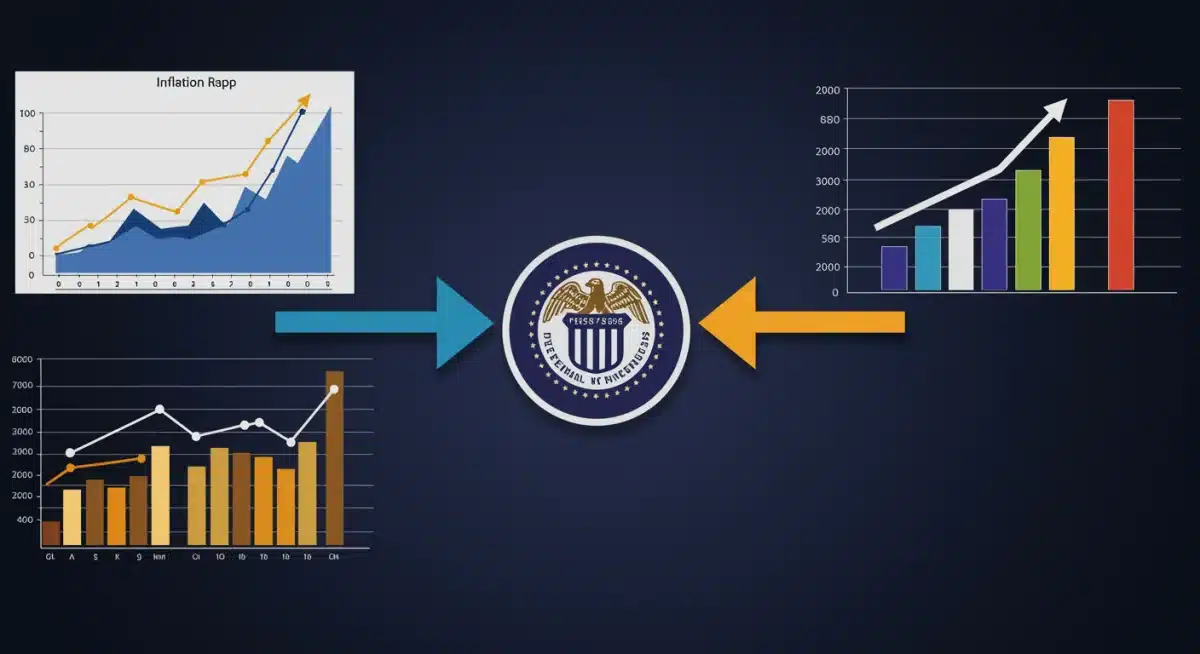
The Fed’s forecasts are not static; they are continuously updated based on incoming data. This adaptive approach means that while initial expectations for 2026 might lean one way, significant economic shifts could lead to a revised strategy. Understanding these potential shifts is key to anticipating future rate decisions.
The interplay between domestic economic health and global events will also be a critical component of the Fed’s assessment. Geopolitical stability, international trade relations, and the economic performance of major trading partners can all indirectly influence the Fed’s stance on interest rates.
inflation targets and the path ahead
The Federal Reserve’s long-term goal for inflation is 2%, as measured by the annual change in the Personal Consumption Expenditures (PCE) price index. This target is not a ceiling but a symmetric objective, meaning the Fed views inflation persistently below or above 2% as equally undesirable. By 2026, how successful the Fed has been in managing inflation will largely shape its interest rate strategy.
After periods of elevated inflation, the path back to a stable 2% can be complex. The Fed monitors a wide range of inflation indicators, including core PCE (which excludes volatile food and energy prices), consumer price index (CPI), and various measures of inflation expectations.
factors influencing inflation in 2026
- Supply Chain Resilience: Improved global supply chains could alleviate price pressures, while new disruptions could reignite them.
- Wage Growth: Strong wage increases, if not accompanied by productivity gains, can contribute to inflationary pressures.
- Energy Prices: Global energy markets remain a significant wild card, with potential impacts on overall price levels.
The Fed’s strategy in 2026 will likely involve a careful assessment of whether inflation has firmly anchored at its target. If inflation remains stubbornly high, the Fed might need to maintain a restrictive stance for longer than anticipated. Conversely, if disinflationary forces dominate, they might have more room to adjust rates downwards.
Furthermore, the public’s inflation expectations are a critical component. If consumers and businesses expect higher inflation, these expectations can become self-fulfilling. The Fed works to anchor these expectations around its 2% target through clear communication and credible policy actions.
potential scenarios for interest rate adjustments
Predicting the exact trajectory of interest rates in 2026 is challenging, but we can outline several plausible scenarios based on current economic understanding and the Federal Reserve’s historical responses. These scenarios range from continued tightening to potential rate cuts, each with distinct implications.
The Fed’s decisions are data-dependent, meaning their strategy will evolve with economic conditions. Therefore, flexibility will remain a hallmark of their approach. Market participants will be closely watching for any signals or forward guidance that hint at the Fed’s preferred path.
scenario 1: continued restrictive policy
If inflation proves more persistent than expected, or if economic growth remains robust despite higher rates, the Fed might opt to maintain a restrictive monetary policy throughout 2026. This would imply:
- Interest rates remaining elevated to cool aggregate demand.
- A focus on ensuring inflation expectations do not become unanchored.
- Potential for further, albeit smaller, rate hikes if necessary.
scenario 2: gradual rate cuts
Should inflation return to the 2% target and the labor market show signs of cooling without a significant recession, the Fed might begin a cycle of gradual rate cuts. This would aim to:
- Prevent an overly restrictive policy from stifling economic growth.
- Support a soft landing for the economy.
- Signal confidence in the economy’s ability to maintain price stability.
Another scenario could involve the Fed holding rates steady for an extended period, assessing the cumulative impact of past adjustments before making further moves. This ‘wait and see’ approach would be employed if economic signals are mixed, providing time for clearer trends to emerge.
Each scenario carries different risks and opportunities for various sectors of the economy. Businesses and consumers should prepare for a range of possibilities, understanding that the Fed’s ultimate goal is long-term economic stability.
impact on various sectors of the us economy
The Federal Reserve’s interest rate strategy in 2026 will reverberate across virtually every sector of the U.S. economy. From housing and consumer spending to corporate investments and government debt, the cost of borrowing money is a fundamental economic lever.
Businesses, especially those reliant on financing for expansion or inventory, will closely monitor rate movements. Higher rates typically translate to higher borrowing costs, potentially slowing investment and hiring. Conversely, lower rates can stimulate economic activity.
sectoral implications
- Housing Market: Mortgage rates are directly tied to the Fed’s policy. Higher rates can cool demand, making homeownership less affordable, while lower rates can stimulate it.
- Consumer Spending: Interest rates affect credit card rates, auto loans, and other consumer financing. Higher costs can dampen discretionary spending.
- Corporate Investment: Businesses consider borrowing costs when making capital expenditure decisions. A higher rate environment can lead to delayed or canceled projects.
- Government Debt: The cost of servicing the national debt can increase significantly with higher interest rates, impacting fiscal policy decisions.
The financial sector, including banks and other lending institutions, is particularly sensitive to interest rate changes. Their profitability often depends on the spread between what they pay for deposits and what they earn on loans. A dynamic rate environment presents both opportunities and challenges.
Understanding these impacts allows businesses and individuals to strategically plan for the future. Adapting to the anticipated shifts in the Fed’s interest rate strategy will be crucial for navigating the economic landscape of 2026 effectively.
the role of global economic factors and geopolitics
While the Federal Reserve primarily focuses on domestic economic conditions, the interconnectedness of the global economy means that international factors and geopolitical events can significantly influence its interest rate strategy. By 2026, the global landscape will undoubtedly present its own set of complexities.
Economic growth or slowdowns in major trading partners, currency fluctuations, and international capital flows can all have ripple effects on the U.S. economy, impacting inflation, demand, and financial stability. The Fed must consider these external forces when formulating its policy.
key global considerations
- Global Growth Outlook: A strong global economy can boost U.S. exports and economic activity, while a downturn abroad could dampen demand.
- International Capital Flows: Changes in global investment patterns, influenced by interest rate differentials, can affect the dollar’s value and U.S. asset prices.
- Geopolitical Stability: Conflicts, trade disputes, and other geopolitical tensions can disrupt supply chains, impact commodity prices, and create uncertainty, all of which the Fed must factor into its outlook.
The Fed’s policy decisions also have international implications, influencing central banks around the world. A significant shift in U.S. interest rates can lead to capital outflows from other nations, currency volatility, and pressure on other central banks to adjust their own policies.
Therefore, when analyzing the Fed’s 2026 strategy, it’s essential to adopt a broad perspective that includes the intricate web of global economic and political dynamics. These external factors add layers of complexity to an already challenging task of monetary policy management.
communication and market expectations
Effective communication is a cornerstone of modern central banking, and the Federal Reserve is no exception. In 2026, the Fed’s ability to clearly articulate its interest rate strategy and rationale will be paramount in managing market expectations and ensuring policy effectiveness.
Ambiguity can lead to market volatility and misinterpretations, potentially undermining the Fed’s objectives. Through speeches, meeting minutes, and press conferences, the Fed aims to provide transparency and forward guidance, helping market participants anticipate future policy moves.
tools for communication
- FOMC Statements: Official announcements following Federal Open Market Committee meetings that detail policy decisions and economic outlook.
- Summary of Economic Projections (SEP): Quarterly releases that include FOMC participants’ projections for GDP growth, unemployment, inflation, and the federal funds rate.
- Press Conferences: The Fed Chair’s post-meeting press conferences provide an opportunity for further clarification and context.
Market expectations, in turn, can influence economic outcomes even before the Fed takes official action. If markets anticipate a rate hike, for example, long-term interest rates might rise in advance, tightening financial conditions. The Fed carefully monitors these expectations, using them as another input into its policy deliberations.
By fostering clear and consistent communication, the Federal Reserve seeks to minimize uncertainty and guide the economy towards its dual mandate objectives with greater stability. The effectiveness of their 2026 interest rate strategy will depend not only on the decisions made but also on how those decisions are communicated and received by the public and financial markets.
| Key Aspect | Brief Description |
|---|---|
| Dual Mandate | Maximum employment and price stability (2% inflation target). |
| Economic Forecasts | Influence from inflation, labor market, and GDP growth predictions. |
| Rate Scenarios | Potential for continued restrictive policy or gradual rate cuts. |
| Global Factors | Geopolitics and international economic trends influencing policy. |
frequently asked questions about the fed’s 2026 strategy
The Federal Reserve’s primary goal is to achieve maximum employment and maintain price stability, typically targeting a 2% inflation rate. These objectives guide all decisions regarding the federal funds rate and other monetary policy tools.
Economic forecasts for inflation, unemployment, and GDP growth are crucial. The Fed uses these projections to anticipate future economic conditions and adjust its interest rate strategy proactively to meet its dual mandate goals.
Possible scenarios include continued restrictive policy if inflation persists, or gradual rate cuts if inflation stabilizes around 2% and the labor market cools. A ‘wait and see’ approach is also plausible amidst mixed economic signals.
Interest rate changes directly affect mortgage rates. Higher rates could cool housing demand and affordability, while lower rates might stimulate activity. The housing market is highly sensitive to the Fed’s monetary policy adjustments.
Clear communication helps manage market expectations, reduces volatility, and enhances the effectiveness of monetary policy. Transparent forward guidance allows businesses and investors to anticipate changes and plan accordingly, fostering greater economic stability.
conclusion
Navigating The Federal Reserve’s 2026 Interest Rate Strategy: An Insider Look at Anticipated Shifts reveals a complex interplay of domestic economic indicators, global forces, and strategic communication. The Fed’s commitment to its dual mandate of maximum employment and price stability will continue to guide its decisions, adapting to evolving circumstances. While precise predictions remain elusive, understanding the potential scenarios and their broad implications allows for better preparedness across all sectors of the U.S. economy. The coming years will undoubtedly test the Fed’s agility and resolve in maintaining a stable and prosperous economic environment.