US Economic Outlook 2026: Growth & Inflation Forecasts

The US economic outlook for 2026 forecasts a period of sustained, albeit moderate, growth driven by resilient consumer spending and strategic investments, with inflation gradually normalizing towards long-term targets.
As we navigate the complexities of the global financial landscape, understanding the US economic outlook 2026 becomes paramount for businesses, policymakers, and individual citizens alike. What does the future hold for growth, inflation, and the overall health of the American economy? This article delves into the key predictions, offering insights into the forces shaping the nation’s financial trajectory.
Forecasting GDP Growth in 2026
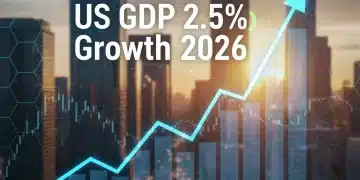
The Gross Domestic Product (GDP) is a primary indicator of economic health, and its trajectory in 2026 will be closely watched. Current projections suggest a period of moderate but steady growth, moving beyond the immediate post-pandemic recovery and adapting to new global realities. Analysts anticipate a growth rate that reflects a maturing economic cycle, balancing expansion with sustainability.
Several factors are expected to contribute to this projected growth. Consumer spending, historically a robust component of the US economy, is likely to remain a significant driver, albeit with potential shifts in consumption patterns. Business investment in technology and infrastructure will also play a crucial role, boosting productivity and creating new economic opportunities. Government spending, particularly on initiatives related to climate change and domestic manufacturing, could provide additional impetus.
Key Drivers of GDP Expansion
- Technological Innovation: Continued advancements in AI, automation, and biotechnology are expected to fuel new industries and enhance efficiency across sectors.
- Resilient Consumer Demand: Despite inflationary pressures, a strong labor market and accumulated savings from previous years are likely to support spending.
- Infrastructure Investment: Ongoing federal and state-level projects in infrastructure will create jobs and improve logistical capabilities.
- Green Economy Transition: Investments in renewable energy and sustainable technologies are poised to become significant economic engines.
However, potential headwinds include geopolitical instability, supply chain vulnerabilities, and the ongoing challenge of labor shortages in certain sectors. The ability of the US economy to adapt to these challenges will largely determine the extent of its growth. Overall, GDP growth in 2026 is expected to settle into a rhythm that prioritizes stability over rapid expansion, aiming for a more balanced and sustainable economic environment.
Understanding Inflation Rates in 2026
Inflation has been a dominant economic theme in recent years, prompting significant policy responses from the Federal Reserve. For 2026, the consensus among economists points towards a continued moderation of inflation rates, gradually converging towards the Fed’s long-term target of 2%. This normalization will be a critical development for both consumers and businesses.
The factors contributing to this anticipated moderation are multifaceted. Supply chain issues, which were a major driver of elevated inflation, are expected to largely resolve or become more manageable. Energy prices, while always subject to geopolitical events, are projected to stabilize. Furthermore, the lagged effects of past monetary policy tightening will continue to exert downward pressure on prices.
Factors Influencing Price Stability
- Monetary Policy Effectiveness: The Federal Reserve’s actions, including interest rate adjustments, will continue to influence aggregate demand and price levels.
- Supply Chain Normalization: Improved global logistics and increased production capacity are expected to ease inflationary pressures from goods.
- Wage Growth Moderation: While a strong labor market persists, a gradual moderation in wage growth could reduce cost-push inflation.
- Commodity Price Stability: Assuming no major geopolitical shocks, commodity prices are expected to remain relatively stable.
Despite the general trend towards moderation, certain sectors might still experience elevated price pressures due to specific supply-demand imbalances or regulatory changes. Services inflation, in particular, might prove stickier than goods inflation. The Federal Reserve will likely remain vigilant, ready to adjust its stance if inflation deviates significantly from its target. The goal is to achieve a soft landing, where inflation returns to target without triggering a recession, making the path to 2026 crucial for assessing policy effectiveness.
Labor Market Dynamics and Employment Trends
The US labor market has shown remarkable resilience, and this trend is largely expected to continue into 2026. While the pace of job creation may slow from its post-pandemic highs, the market is projected to remain robust, characterized by low unemployment rates and sustained wage growth. However, the nature of employment and the skills demanded will continue to evolve.
Automation and artificial intelligence will increasingly reshape job roles, leading to a greater demand for specialized skills in technology, data analysis, and creative problem-solving. Education and vocational training programs will play an even more critical role in bridging the skills gap and ensuring a dynamic workforce. The gig economy is also likely to expand further, offering flexibility but also posing new challenges for worker benefits and protections.
Key Employment Developments
- Skills Gap Persistence: Demand for tech-savvy workers will outpace supply, necessitating ongoing education and training initiatives.
- Remote Work Evolution: Hybrid work models are likely to become the standard, influencing office space demand and urban planning.
- Demographic Shifts: An aging workforce will continue to impact labor participation rates and the availability of experienced professionals.
- Gig Economy Expansion: More individuals may opt for flexible, contract-based work, requiring new policy considerations.
Wage growth, while moderating from its recent peaks, is still expected to outpace inflation, contributing to real income gains for many workers. This will support consumer spending and overall economic stability. However, disparities in wage growth across different sectors and skill levels could persist, highlighting the need for targeted policies to promote equitable economic opportunities. The labor market in 2026 will be a testament to the US economy’s adaptability and its capacity for innovation.
Federal Reserve Policy and Interest Rate Projections
The Federal Reserve’s monetary policy will remain a pivotal factor influencing the US economic landscape in 2026. Having aggressively raised interest rates to combat inflation, the Fed is expected to adopt a more measured and data-dependent approach. The primary objective will continue to be price stability alongside maximum sustainable employment.
By 2026, many economists anticipate that the federal funds rate will have settled into a more normalized range, reflecting a neutral monetary policy stance. This means that interest rates will likely be neither overly restrictive nor overly accommodative, aiming to support economic growth without reigniting inflationary pressures. However, the exact path of interest rates will depend heavily on incoming economic data, particularly regarding inflation and labor market conditions.
Anticipated Policy Shifts
- Data-Dependent Decisions: The Fed will prioritize economic data over predetermined paths for interest rate adjustments.
- Balance Sheet Management: Quantitative tightening may continue, gradually reducing the Fed’s balance sheet to a more sustainable level.
- Inflation Target Vigilance: Maintaining inflation at the 2% target will remain a core focus, with readiness to act if deviations occur.
- Communication Clarity: Transparent communication will be crucial to manage market expectations and provide economic stability.
The Fed’s communication strategy will be crucial in guiding market expectations and ensuring financial stability. Any sudden shifts in policy could lead to market volatility. The central bank will likely emphasize flexibility and a commitment to its dual mandate. The interest rate environment in 2026 will reflect the culmination of the Fed’s efforts to steer the economy through a period of elevated inflation, aiming for long-term stability and sustainable growth.

Technological Advancements and Economic Impact
The year 2026 is poised to witness the continued acceleration of technological advancements, profoundly impacting various facets of the US economy. Artificial intelligence (AI), machine learning, and automation are no longer nascent concepts but integral components reshaping industries from manufacturing to healthcare and finance. These innovations promise to boost productivity, create new markets, and redefine the future of work.
The integration of AI into business operations will lead to more efficient processes, personalized consumer experiences, and enhanced decision-making. This will drive significant investment in research and development, creating high-value jobs and fostering a competitive edge. Furthermore, the expansion of 5G and nascent 6G networks will underpin the growth of the Internet of Things (IoT), connecting devices and generating vast amounts of data that can be leveraged for economic gain.
Transformative Technologies
- AI and Machine Learning: Revolutionizing automation, data analysis, and predictive modeling across sectors.
- Quantum Computing: Though still in early stages, breakthroughs could unlock unprecedented computational power, impacting encryption, finance, and drug discovery.
- Biotechnology and Gene Editing: Advancements in healthcare and agriculture promise new treatments, improved crop yields, and ethical considerations.
- Renewable Energy Innovations: Continued development in solar, wind, and battery storage technologies will drive the energy transition and create new economic opportunities.
While technological progress offers immense opportunities, it also presents challenges, such as the need for workforce retraining, ethical considerations in AI deployment, and ensuring equitable access to new technologies. Policymakers will be tasked with fostering an environment that encourages innovation while mitigating potential negative externalities. The economic impact of these advancements in 2026 will be characterized by both significant disruption and unprecedented growth potential.
Global Economic Influences on the US in 2026
The US economy does not operate in isolation; it is intricately linked to the global economic landscape. In 2026, international trade dynamics, geopolitical stability, and the economic performance of major trading partners will continue to exert significant influence. Understanding these external factors is crucial for a comprehensive US economic outlook 2026.
China’s economic trajectory, for instance, will remain a key determinant. Its growth, or lack thereof, will impact global supply chains and demand for US exports. Similarly, the economic health of the European Union and other major economies will affect global trade volumes and investment flows. Geopolitical tensions, particularly in critical regions, could disrupt energy markets and supply routes, leading to unforeseen economic consequences.
External Factors Shaping the US Economy
- Geopolitical Stability: Conflicts or major political shifts in key regions can disrupt trade, energy supplies, and investor confidence.
- Global Trade Agreements: Evolutions in international trade policies and agreements will impact export and import dynamics for the US.
- Emerging Market Growth: The economic performance of developing nations can create new markets for US goods and services, or pose competitive challenges.
- Climate Change Policies: Global efforts to combat climate change will influence energy markets, manufacturing, and international cooperation.
Currency fluctuations, driven by interest rate differentials and economic performance, will also affect the competitiveness of US exports and the cost of imports. A stronger dollar can make US goods more expensive abroad, while a weaker dollar can fuel inflation. The interconnectedness of global financial markets means that economic shocks in one region can quickly propagate, requiring agile policy responses from the US. Navigating these global influences effectively will be key to maintaining robust economic health in 2026.
| Key Economic Indicator | 2026 Prediction |
|---|---|
| GDP Growth | Moderate, sustained expansion (2.0% – 2.5%) |
| Inflation Rate | Gradual convergence to Fed’s 2% target |
| Unemployment Rate | Low and stable, reflecting a robust labor market |
| Federal Funds Rate | Normalized, neutral policy stance |
Frequently Asked Questions About the 2026 US Economic Outlook
Primary drivers for US economic growth in 2026 are expected to be resilient consumer spending, significant business investment in technology and infrastructure, and strategic government spending on key initiatives like green energy and domestic manufacturing. These factors are anticipated to foster moderate but sustained expansion.
Inflation rates in the US are projected to continue their moderation in 2026, gradually moving towards the Federal Reserve’s target of 2%. This stabilization is expected due to resolving supply chain issues, stabilizing energy prices, and the lagged effects of prior monetary policy tightening measures.
Technological advancements, particularly AI and automation, will significantly reshape the US labor market by 2026. They are expected to boost productivity and create new job roles, increasing demand for specialized skills in technology and data. This will necessitate ongoing workforce retraining and education.
The Federal Reserve will play a crucial role in 2026, adopting a data-dependent approach to monetary policy. Its primary aim will be to maintain price stability and maximum employment, with interest rates likely settling into a neutral range. Their flexibility and communication will be key to market stability.
Yes, significant global risks could affect the US economy in 2026, including geopolitical instability, disruptions in international trade dynamics, and the economic performance of major trading partners like China and the EU. These external factors can influence supply chains, energy markets, and investment flows.
Conclusion
The US economic outlook 2026 paints a picture of continued adaptation and resilience. While challenges such as geopolitical uncertainties and evolving labor market demands persist, the underlying strengths of the American economy—driven by innovation, consumer spending, and strategic investments—are expected to foster moderate growth and a gradual return to inflation stability. Vigilant policymaking, particularly from the Federal Reserve, combined with proactive responses to technological shifts and global influences, will be crucial in navigating the economic landscape. For individuals and businesses, understanding these trends will be vital for informed decision-making and capitalizing on emerging opportunities in a dynamic financial future.