Debt Snowball vs. Debt Avalanche: Which Strategy Saves You More Money by 2027?
In the journey towards financial freedom, one of the most significant hurdles many individuals face is debt. Whether it’s credit card balances, student loans, or personal loans, the weight of debt can be overwhelming. However, with the right strategy, becoming debt-free isn’t just a dream – it’s an achievable goal. Two of the most popular and effective debt payoff strategies are the debt snowball and the debt avalanche. Both methods aim to eliminate debt, but they approach the problem from different angles, leading to distinct financial and psychological outcomes. By 2027, you could be living a debt-free life, but choosing the optimal strategy is key.
This comprehensive guide will delve into the intricacies of both the debt snowball and debt avalanche methods. We’ll explore how each strategy works, analyze their pros and cons, and, most importantly, help you determine which one will save you more money and accelerate your path to financial independence by 2027. Understanding these approaches is not just about crunching numbers; it’s about aligning a strategy with your personal finance personality and long-term goals.
Understanding the Debt Snowball Method
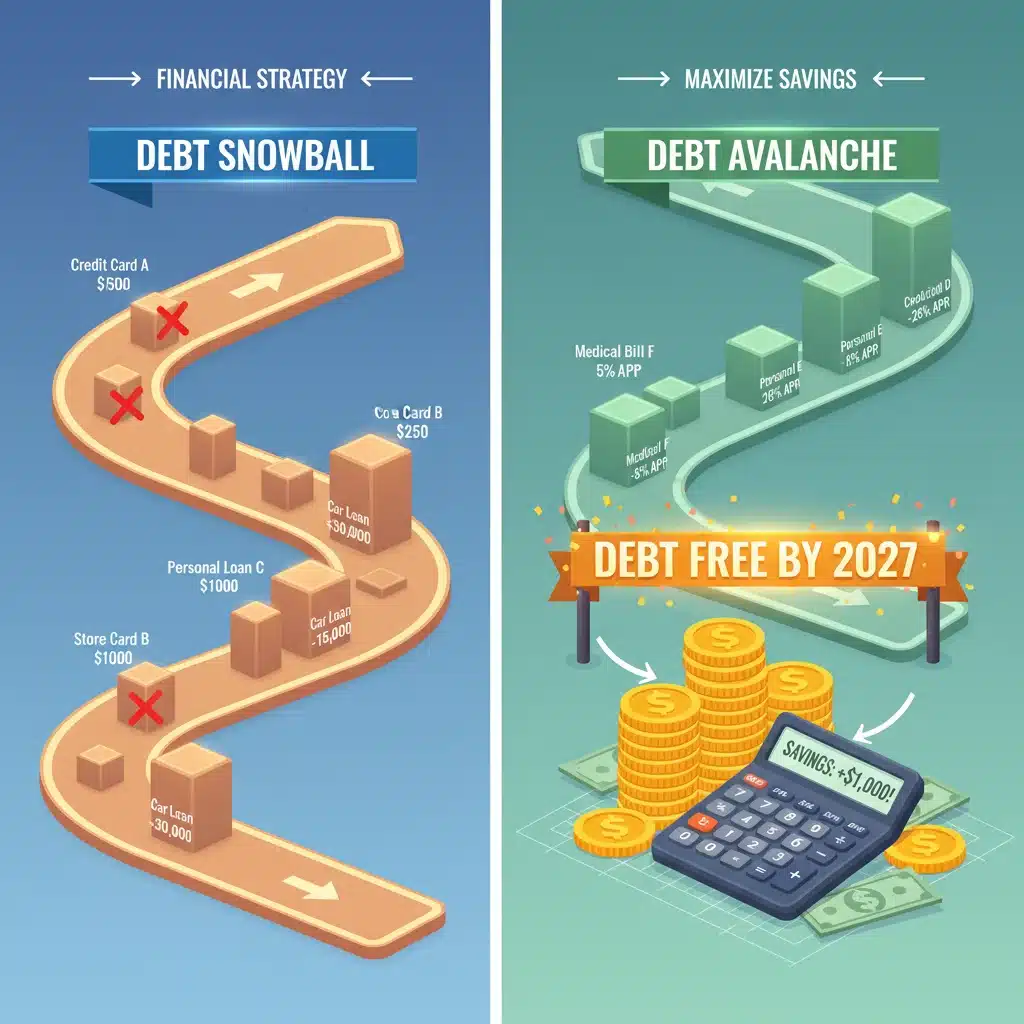
The debt snowball method, popularized by financial guru Dave Ramsey, is a debt reduction strategy where you pay off debts in order from smallest balance to largest. The core idea behind this approach is psychological motivation. When you pay off a small debt, you gain momentum and a sense of accomplishment, which then propels you to tackle the next debt.
How the Debt Snowball Works:
- List All Your Debts: Start by listing all your debts, regardless of interest rate, from the smallest total balance to the largest.
- Make Minimum Payments: For all debts except the smallest, continue to make only the minimum required payments.
- Attack the Smallest Debt: Focus all your extra money and resources on paying off the debt with the smallest balance. This means making the minimum payment plus any additional funds you can spare.
- Roll the Payment: Once the smallest debt is paid off, take the money you were paying on that debt (both minimum and extra) and add it to the minimum payment of the next smallest debt. This creates a ‘snowball’ effect, where the amount you’re paying towards each subsequent debt grows larger and larger.
- Repeat: Continue this process until all your debts are paid off.
Pros of the Debt Snowball:
- Psychological Boost: The primary advantage of the debt snowball is the quick wins it provides. Eliminating smaller debts quickly can be incredibly motivating, keeping you engaged and committed to the process. This is particularly beneficial for individuals who need consistent encouragement to stay on track.
- Momentum Building: Each debt paid off creates a sense of accomplishment and builds momentum, making it easier to stick with the plan. This psychological aspect can be a powerful tool for long-term adherence to a debt repayment plan.
- Simplicity: It’s straightforward to understand and implement, making it accessible for everyone, regardless of their financial literacy level.
Cons of the Debt Snowball:
- Potentially More Interest Paid: Because this method prioritizes debt size over interest rates, you might end up paying more in interest over the long run, especially if your smallest debts have low interest rates and your larger debts have high interest rates. This is the main financial drawback.
- Slower Financial Progress (Initially): While psychologically faster, the actual financial progress in terms of total interest saved can be slower compared to strategies that target high-interest debts first.
Understanding the Debt Avalanche Method
In contrast to the debt snowball, the debt avalanche method is a financially optimized debt payoff strategy. This approach focuses on minimizing the total amount of interest paid by prioritizing debts with the highest interest rates first, regardless of their balance. This method is favored by financial experts because it saves you the most money in the long run.
How the Debt Avalanche Works:
- List All Your Debts: Gather all your debts and list them in order from the highest interest rate to the lowest interest rate.
- Make Minimum Payments: Just like with the snowball method, make only the minimum required payments on all your debts except for the one with the highest interest rate.
- Attack the Highest Interest Debt: Direct all your extra funds and any additional payments towards the debt with the highest interest rate. This means paying its minimum payment plus as much extra as you can afford.
- Roll the Payment: Once the highest interest debt is completely paid off, take the total amount you were paying on it (minimum + extra) and apply it to the next debt on your list, which will be the one with the second-highest interest rate.
- Repeat: Continue this process, systematically eliminating debts from highest interest to lowest, until all your debts are gone.
Pros of the Debt Avalanche:
- Saves the Most Money: This is the biggest advantage. By tackling high-interest debts first, you reduce the overall amount of interest you pay, leading to significant savings over the life of your debt. This financial efficiency is what makes it a powerhouse among debt payoff strategies.
- Faster Debt Elimination (Financially): Although it might not feel as fast psychologically at the beginning, the debt avalanche typically leads to a faster overall debt elimination timeline because more of your payment goes towards the principal rather than interest.
- Mathematically Optimal: From a purely financial perspective, the debt avalanche is the most efficient way to pay off multiple debts.
Cons of the Debt Avalanche:
- Less Immediate Gratification: If your highest interest debt also happens to be a large balance, it might take a significant amount of time to pay it off. This lack of quick wins can be demotivating for some individuals, especially at the start of their journey.
- Requires Discipline: Because the immediate psychological rewards are fewer, this method requires a higher degree of self-discipline and commitment to see it through.

Debt Snowball vs. Debt Avalanche: A Head-to-Head Comparison for 2027
Now that we’ve explored each method individually, let’s put them side-by-side to see how they stack up, particularly with a goal of being debt-free by 2027. The best debt payoff strategies are those that you can stick with, and that truly align with your financial personality.
Financial Impact: Which Saves More Money by 2027?
Without a doubt, the debt avalanche method will almost always save you more money in interest payments. This is a mathematical certainty. By targeting the debts that are costing you the most money first, you reduce the principal on those expensive loans faster, thereby cutting down the amount of interest that accrues. If your primary goal is to minimize the total cost of your debt by 2027, the debt avalanche is the superior choice.
Consider this scenario: You have three debts:
- Credit Card A: $1,000 balance, 20% interest
- Credit Card B: $5,000 balance, 15% interest
- Personal Loan: $10,000 balance, 8% interest
If you have an extra $200 per month to put towards debt:
- Debt Snowball: You’d pay off Credit Card A first. Once it’s gone, you’d roll that payment to Credit Card B, and so on. This gives you a quick win, but Credit Card B’s 15% interest will still accumulate for longer than if you tackled it sooner.
- Debt Avalanche: You’d tackle Credit Card A (20% interest) first, then Credit Card B (15%), and finally the Personal Loan (8%). This ensures you’re always paying down the most expensive debt, leading to thousands of dollars in interest savings over several years, potentially getting you debt-free sooner with more money in your pocket by 2027.
The difference in total interest paid can be substantial over the course of several years, especially with larger debts and higher interest rates. For someone aiming for efficiency and maximum savings by 2027, the avalanche method is the clear winner.
Psychological Impact: Which Keeps You Motivated?
This is where the debt snowball shines. For many people, seeing debts disappear quickly, even if they are small, provides a powerful psychological boost. This motivation can be crucial for staying committed to a long-term goal like becoming debt-free by 2027. Financial journeys are often as much about mindset as they are about math.
- If you tend to get discouraged easily or need frequent encouragement to stick to a plan, the quick wins of the debt snowball might be more effective for you.
- If you are highly disciplined and motivated by the idea of saving the most money, even if it takes longer to see the first debt disappear, then the debt avalanche will likely work better.
The best debt payoff strategies are those that you can actually stick to. If you start the avalanche method and get discouraged because the first debt takes too long to pay off, you might abandon the plan altogether, which would be far worse than paying a little extra interest with the snowball method.
Implementation and Flexibility
Both methods require discipline in making minimum payments and allocating extra funds. However, the simplicity of ranking by balance (snowball) versus interest rate (avalanche) can also play a role in ease of implementation.
- Debt Snowball: Easier to set up and track due to the simple sorting by balance.
- Debt Avalanche: Requires accurate tracking of interest rates, which can sometimes fluctuate (e.g., variable rate credit cards), adding a slight layer of complexity.
Choosing the Right Debt Payoff Strategy for You by 2027
Deciding between the debt snowball and debt avalanche ultimately comes down to your personal financial behavior and priorities. There’s no one-size-fits-all answer, but by considering your personality and financial goals, you can make an informed decision that will help you achieve debt freedom by 2027.
When to Choose the Debt Snowball:
- If you need quick wins and motivation: If you’ve struggled with debt repayment in the past and need psychological boosts to stay on track, the debt snowball is an excellent choice. The sense of accomplishment from paying off small debts can be incredibly powerful.
- If your debt balances are relatively similar: If your highest-interest debts also happen to be your smallest debts, the snowball method might inadvertently align with the avalanche method, giving you the best of both worlds.
- If you’re new to budgeting and debt management: Its simplicity makes it a great starting point for those just beginning their financial journey.
When to Choose the Debt Avalanche:
- If your primary goal is to save the most money: If you are disciplined and your main priority is to minimize the total amount of interest paid over the life of your debts, the debt avalanche is the mathematically superior choice.
- If you have high-interest debts: Debts like credit card balances with 20%+ interest rates can be incredibly costly. The avalanche method attacks these first, saving you significantly.
- If you are highly motivated by financial efficiency: For those who are comfortable with numbers and driven by optimizing their financial outcomes, the avalanche method provides the most efficient path to debt freedom by 2027.
It’s also worth noting that you don’t have to strictly adhere to one method forever. You might start with the snowball to build momentum, and once you feel confident and disciplined, switch to the avalanche to maximize savings. The most important thing is to choose a strategy and stick with it consistently.
Beyond the Strategy: Essential Tips for Becoming Debt-Free by 2027
While choosing between the debt snowball and debt avalanche is a critical step, it’s just one piece of the puzzle. To truly ensure you’re debt-free by 2027, you need to implement broader financial habits and strategies.
1. Create a Detailed Budget and Stick to It
A budget is your financial roadmap. It helps you understand where your money is going and identify areas where you can cut back to free up more funds for debt repayment. Track every dollar, categorize your spending, and make conscious choices about your expenditures. This is foundational to all effective debt payoff strategies.
2. Increase Your Income
The more money you have, the faster you can pay off debt. Explore options to increase your income, such as:
- Side Hustles: Freelancing, ride-sharing, dog walking, or selling crafts online.
- Overtime at Work: If available and feasible.
- Negotiating a Raise: If you’ve earned it, ask for it.
Even a small increase in income can significantly accelerate your debt repayment timeline, helping you reach your 2027 goal sooner.
3. Reduce Unnecessary Expenses
Take a critical look at your spending habits. Are there subscriptions you don’t use? Can you cook more at home instead of eating out? Small cuts can add up to substantial savings that can be directed towards your debt. Every dollar saved is a dollar that can chip away at your principal.
4. Consider Debt Consolidation or Refinancing (with Caution)
For high-interest debts, consolidating them into a single loan with a lower interest rate can be beneficial. Options include:
- Balance Transfer Credit Cards: Often offer 0% APR for an introductory period, but be sure to pay off the balance before the promotional period ends.
- Personal Loans: Can offer lower fixed interest rates than credit cards.
- Home Equity Loans/Lines of Credit: Use with extreme caution as you are putting your home at risk.
While these can save money on interest, they don’t address the underlying spending habits. Use them as a tool to accelerate your chosen debt payoff strategies, not as a license to incur more debt.
5. Build an Emergency Fund
This might seem counterintuitive when you’re focused on debt, but having a small emergency fund (e.g., $1,000) can prevent you from falling back into debt when unexpected expenses arise. Instead of putting a car repair or medical bill on a credit card, you can use your emergency fund, keeping your debt repayment plan on track towards 2027.
6. Stay Consistent and Patient
Debt repayment is a marathon, not a sprint. There will be good months and challenging months. The key is consistency. Stick to your chosen strategy, make your payments, and celebrate small victories along the way. Remind yourself of your goal: debt-free by 2027.
Real-World Scenarios and Expert Insights
Let’s consider a few real-world examples to illustrate how these debt payoff strategies play out.
Scenario 1: High-Interest Credit Card Debt
Sarah has $15,000 in credit card debt across three cards, all with high-interest rates (22%, 18%, 15%). She also has a $5,000 personal loan at 10% interest. She has an extra $300 per month to apply to debt.
- Debt Snowball Approach: Sarah might pay off her smallest balance first, which could be a card with 15% interest. While she’d get a quick win, her 22% interest card would continue to accrue significant interest.
- Debt Avalanche Approach: Sarah would target the 22% interest credit card first. This would save her substantial money over time, potentially cutting months off her repayment timeline and leaving her with more disposable income by 2027.
In this scenario, the avalanche method is financially more advantageous, especially with the 22% interest rate compounding quickly.
Scenario 2: Low-Balance, Low-Interest Debts
Mark has several small medical bills and a couple of student loans. The medical bills are low balance but also low interest (0-5%), while his student loans are larger balances but also relatively low interest (4-6%). He needs a motivational boost.
- Debt Snowball Approach: Mark would quickly pay off the small medical bills, gaining rapid psychological wins. This momentum would then help him tackle the larger student loans, making the overall process feel less daunting.
- Debt Avalanche Approach: Mark might find himself chipping away at a larger student loan first, with less immediate satisfaction. If he’s prone to losing motivation, this could lead to abandoning the plan.
For Mark, the psychological benefit of the snowball method is likely more valuable, even if he pays a tiny bit more in interest. The goal is to get debt-free by 2027, and staying motivated is key.
Expert Consensus
Financial planners generally advocate for the debt avalanche due to its mathematical superiority in saving money. However, they also acknowledge the power of behavioral economics. If you know you need that psychological boost, the snowball method is a perfectly valid and effective tool. The ‘best’ strategy is the one you will consistently execute.
Many experts suggest trying a hybrid approach: if you have one very small debt, use the snowball to get a quick win, then transition to the avalanche for all subsequent debts. This combines the best of both debt payoff strategies.
Conclusion: Your Path to Debt Freedom by 2027
Both the debt snowball and debt avalanche are powerful debt payoff strategies that can lead you to financial freedom. The debt avalanche is the clear winner if your sole focus is to save the maximum amount of money on interest payments. However, if you’re someone who thrives on quick wins and needs consistent motivation to stay committed, the psychological benefits of the debt snowball might outweigh the slightly higher interest cost.
To make the best decision for your journey to being debt-free by 2027, consider your financial personality, the specifics of your debts (balances and interest rates), and what will keep you most engaged in the process. Remember, the most effective strategy is the one you can stick with until every last debt is paid off. Start today, stay disciplined, and you can achieve your goal of financial independence by 2027.
Whichever method you choose, the crucial steps are the same: list your debts, create a budget, find extra money to apply towards your principal, and maintain unwavering consistency. With dedication, becoming debt-free by 2027 is not just a possibility, but a highly achievable reality.