Powering Prosperity: Tech Advancements & US Productivity Growth by 2026

Powering Prosperity: How Technological Advancements Will Drive 3% US Productivity Growth by 2026
The United States economy stands at a pivotal juncture, poised for a transformative surge in productivity. For decades, economists and policymakers have grappled with the challenge of stagnant productivity growth, a phenomenon that has tempered overall economic expansion and wage increases. However, a confluence of rapid technological advancements, strategic investments, and evolving policy frameworks is setting the stage for a significant acceleration. We are entering an era where a 3% US productivity growth by 2026 is not merely an optimistic projection but a tangible goal, driven largely by the pervasive integration of cutting-edge technologies across all sectors.
Understanding the mechanisms behind this anticipated growth requires a deep dive into the technological landscape. From the burgeoning power of Artificial Intelligence (AI) and machine learning to the widespread adoption of automation, robotics, and the Internet of Things (IoT), these innovations are fundamentally reshaping how work is done, how goods are produced, and how services are delivered. This article will explore the key technological drivers, the sectors most impacted, the necessary policy frameworks, and the challenges and opportunities that lie ahead in achieving and sustaining this ambitious target for US productivity growth.
The Stagnation Challenge and the Promise of a New Era for US Productivity Growth
For much of the 21st century, US productivity growth has been lackluster, averaging well below the rates seen in previous decades. This slowdown has raised concerns about long-term economic prosperity, living standards, and global competitiveness. Several factors contributed to this trend, including the diminishing returns from earlier waves of information technology, an aging workforce, and a shift towards lower-productivity service sectors. However, the current wave of technological innovation is fundamentally different, offering a renewed promise of significant gains.
The promise of a 3% US productivity growth is not just about faster economic expansion; it’s about creating higher-paying jobs, improving living standards, and enhancing the nation’s global competitive edge. This level of growth would signal a robust and dynamic economy, capable of absorbing shocks and driving innovation. It would also provide the resources necessary to address pressing societal challenges, from healthcare to infrastructure.
Key Technological Drivers Fueling Future US Productivity Growth
The engine of this anticipated productivity surge is multifaceted, powered by several interconnected technological advancements. Each of these innovations, both individually and in synergy, contributes to increased efficiency, reduced costs, and enhanced output.
Artificial Intelligence (AI) and Machine Learning (ML)
AI and ML are perhaps the most transformative technologies on the horizon. Their ability to analyze vast datasets, identify patterns, and make predictions with unprecedented accuracy is revolutionizing nearly every industry. In manufacturing, AI-powered predictive maintenance reduces downtime and optimizes production schedules. In healthcare, AI assists in diagnostics, drug discovery, and personalized treatment plans, leading to better outcomes and more efficient resource allocation. Financial services leverage AI for fraud detection, algorithmic trading, and personalized customer service. The administrative burden across sectors is being significantly lightened by AI-driven automation of routine tasks, freeing human capital for more complex, creative, and strategic endeavors. The impact of AI on US productivity growth cannot be overstated, as it enhances decision-making and operational efficiency at every level.
Automation and Robotics
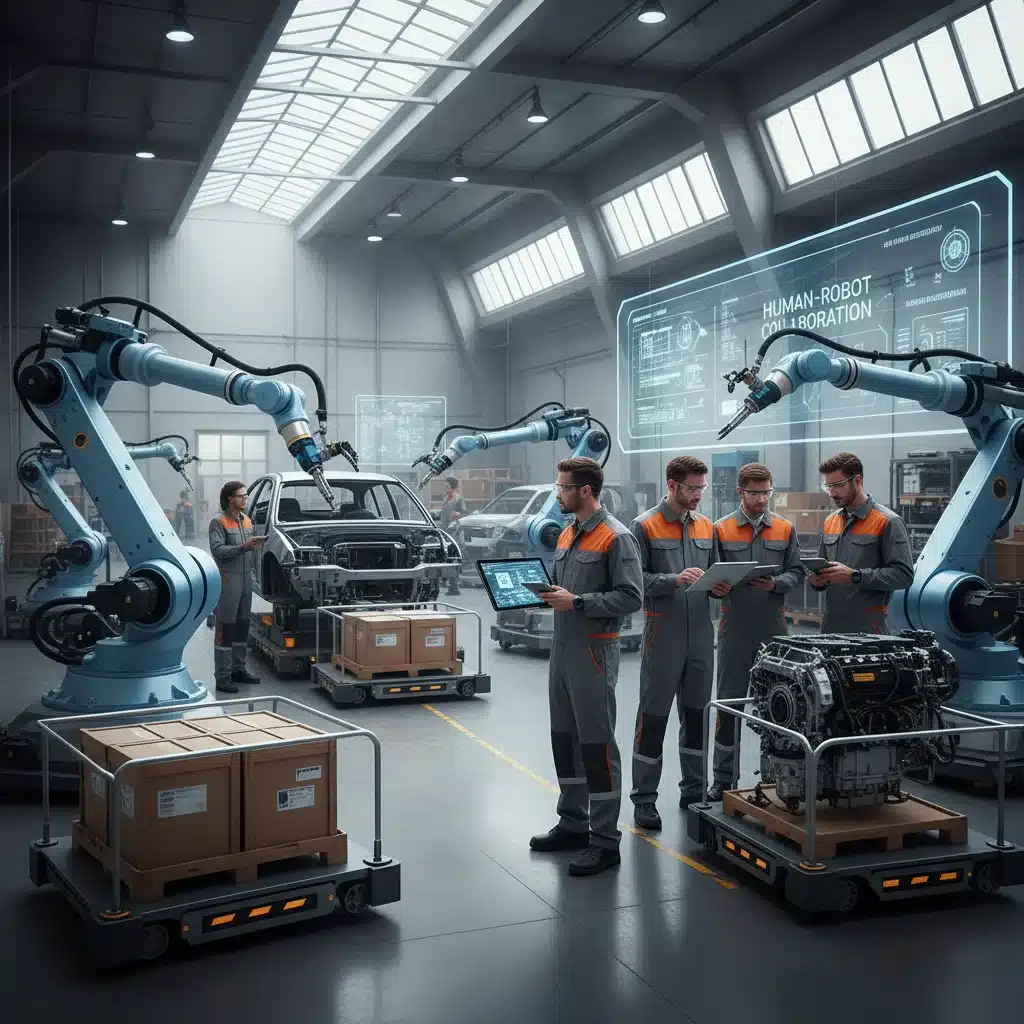
Beyond the factory floor, automation and robotics are expanding their reach into logistics, retail, and even service industries. Advanced robotics, equipped with AI capabilities, can perform complex tasks with precision and speed, often in environments unsuitable for humans. This leads to higher production volumes, fewer errors, and significant cost savings. Collaborative robots (cobots) are increasingly working alongside human employees, augmenting capabilities rather than replacing them entirely. The logistics sector, for instance, is seeing massive productivity gains through automated warehouses and drone delivery systems. This widespread adoption of automation is a direct contributor to improved US productivity growth.
Internet of Things (IoT)
The IoT, with its vast network of interconnected devices, sensors, and machines, generates an enormous amount of real-time data. This data, when analyzed effectively, provides invaluable insights into operational performance, resource utilization, and potential inefficiencies. Smart factories use IoT sensors to monitor every stage of production, identifying bottlenecks and optimizing workflows. Smart cities leverage IoT for traffic management, energy efficiency, and public safety. The ability to collect and act upon real-time data allows businesses to make more informed decisions, leading to leaner operations and substantial gains in US productivity growth.
Cloud Computing and Big Data Analytics
Cloud computing provides the scalable infrastructure necessary to process and store the massive amounts of data generated by AI, IoT, and other digital technologies. Big data analytics tools then extract actionable insights from this data, empowering businesses to understand market trends, customer behavior, and operational performance with unprecedented clarity. This combination enables faster innovation cycles, more targeted product development, and more efficient resource allocation, all critical factors for boosting US productivity growth.
5G Technology
The rollout of 5G networks is not just about faster internet speeds for consumers; it’s a foundational technology that unlocks the full potential of IoT, AI, and autonomous systems. Its low latency and high bandwidth are crucial for real-time data transfer in applications like autonomous vehicles, remote surgery, and interconnected smart factories. 5G facilitates seamless communication between devices and systems, leading to more integrated and efficient operations across various industries, thereby accelerating US productivity growth.
Sector-Specific Impacts: Where US Productivity Growth Will Flourish
While technological advancements have a broad impact, certain sectors are particularly ripe for significant productivity gains, acting as spearheads for overall US productivity growth.
Manufacturing
Manufacturing is undergoing a renaissance, driven by advanced robotics, AI-driven process optimization, and additive manufacturing (3D printing). Smart factories, characterized by highly automated and interconnected systems, are becoming the norm. These factories can produce goods with greater precision, less waste, and faster turnaround times. The ability to customize products on demand and respond quickly to market changes significantly enhances efficiency and output. This sector is a prime example of how technology directly translates into tangible US productivity growth.
Healthcare
Healthcare is poised for a dramatic transformation. AI is revolutionizing diagnostics, enabling earlier and more accurate disease detection. Robotics are assisting in surgeries, improving precision and reducing recovery times. Telemedicine and remote monitoring, powered by IoT, are expanding access to care and reducing the burden on physical facilities. Administrative tasks, a significant drain on healthcare resources, are being automated, allowing medical professionals to focus more on patient care. These innovations lead to better patient outcomes, reduced costs, and a more efficient healthcare system, contributing to national US productivity growth.
Logistics and Supply Chain Management
The COVID-19 pandemic highlighted the vulnerabilities of global supply chains. Technology is providing the solutions. AI-powered demand forecasting, automated warehouses, drone delivery, and blockchain for transparent tracking are creating more resilient, efficient, and responsive supply chains. Real-time data from IoT devices allows for optimal route planning and inventory management, minimizing delays and waste. The ability to move goods more efficiently and reliably is a direct boon to US productivity growth.
Agriculture
Precision agriculture, utilizing drones, IoT sensors, and AI, is transforming farming. Farmers can monitor crop health, soil conditions, and livestock with unprecedented detail, optimizing irrigation, fertilization, and pest control. Automated machinery for planting and harvesting increases efficiency and reduces labor costs. This leads to higher yields, reduced resource consumption, and a more sustainable and productive agricultural sector, contributing to overall US productivity growth.
The Role of Policy and Investment in Sustaining US Productivity Growth
Achieving a 3% US productivity growth by 2026 is not solely dependent on technological innovation; it also requires supportive policy frameworks and strategic investments. Government and private sector collaboration will be crucial.
Investment in Research and Development (R&D)
Continued and expanded investment in R&D, both public and private, is fundamental. This includes funding for basic scientific research, as well as incentives for companies to invest in developing and deploying new technologies. Tax credits for R&D and grants for innovative startups can foster a vibrant ecosystem of technological advancement, directly impacting future US productivity growth.
Education and Workforce Development
The rapid pace of technological change necessitates a continuous evolution of the workforce. Investments in education and retraining programs are essential to equip workers with the skills needed for the jobs of tomorrow. This includes STEM education, digital literacy, and vocational training in areas like robotics and AI programming. A skilled workforce is critical to adopting and leveraging new technologies effectively, thereby driving US productivity growth.
Infrastructure Development
Robust digital infrastructure, including widespread access to high-speed internet and 5G networks, is a prerequisite for widespread technology adoption. Investments in physical infrastructure, such as smart grids and advanced transportation networks, also contribute indirectly to productivity by reducing bottlenecks and improving efficiency across the economy. Without this foundational infrastructure, the potential for US productivity growth would be limited.
Regulatory Frameworks
Policymakers must strike a delicate balance between fostering innovation and ensuring responsible development. Agile regulatory frameworks that can adapt to new technologies while addressing concerns around data privacy, cybersecurity, and ethical AI use are vital. Clear guidelines can reduce uncertainty for businesses and encourage investment, supporting sustainable US productivity growth.
Addressing Challenges and Maximizing Opportunities for US Productivity Growth
While the prospects for enhanced US productivity growth are promising, several challenges must be addressed to fully realize this potential.
Digital Divide and Equitable Access
The benefits of technology must be broadly distributed to avoid exacerbating existing inequalities. Bridging the digital divide, ensuring access to high-speed internet in rural and underserved areas, and providing affordable access to digital tools and training are crucial. An inclusive approach will ensure that all segments of society contribute to and benefit from US productivity growth.
Cybersecurity Risks
As economies become more interconnected and reliant on digital systems, the threat of cyberattacks grows. Robust cybersecurity measures, both at the individual business level and through national strategies, are essential to protect critical infrastructure and proprietary data. A secure digital environment is foundational for sustained US productivity growth.
Job Displacement and Reskilling
Automation and AI will inevitably lead to some job displacement in certain sectors. Proactive measures, including comprehensive reskilling and upskilling programs, social safety nets, and policies that encourage job creation in new technology-driven industries, are necessary to manage this transition effectively. The goal is to ensure that technological progress creates more opportunities than it displaces, contributing positively to US productivity growth rather than causing social disruption.

Ethical AI Development
The ethical implications of AI, including bias in algorithms, privacy concerns, and accountability, must be carefully considered. Developing ethical guidelines and frameworks for AI development and deployment will build public trust and ensure that these powerful technologies are used for the greater good, sustainably contributing to US productivity growth.
The Path Forward: A Vision for 3% US Productivity Growth
Achieving a 3% US productivity growth by 2026 is an ambitious but attainable goal. It requires a concerted effort from government, industry, and academia. The foundational technologies are already here, and their capabilities are rapidly expanding. The focus now must be on widespread adoption, effective integration, and the creation of an environment that nurtures innovation and supports a skilled workforce.
The economic benefits of such a surge in productivity are immense. It would lead to higher wages, increased investment, greater competitiveness on the global stage, and enhanced capacity to address societal challenges. The United States has a history of leveraging technological revolutions to drive economic prosperity, and the current era of AI, automation, and interconnected systems presents another such opportunity.
By prioritizing strategic investments in R&D, education, and infrastructure, while simultaneously developing adaptive regulatory frameworks and addressing the social implications of technological change, the US can unlock a new era of sustained economic growth. The vision of a 3% US productivity growth by 2026 is not just an economic indicator; it represents a future of greater prosperity, innovation, and opportunity for all Americans.
Conclusion: Embracing the Future of US Productivity Growth
The journey towards a 3% US productivity growth by 2026 is a testament to the nation’s enduring spirit of innovation and its capacity for adaptation. The transformative power of technologies like AI, automation, IoT, and 5G is undeniable. These advancements are not just incremental improvements; they represent a paradigm shift in how we work, produce, and innovate. While challenges such as the digital divide, cybersecurity, and workforce reskilling must be actively managed, the opportunities far outweigh the risks.
The path to higher productivity is paved with strategic foresight, collaborative effort, and a commitment to continuous learning and adaptation. As we move closer to 2026, the integration of these technological marvels will not only redefine economic metrics but also reshape the very fabric of American society, fostering a more prosperous, efficient, and technologically advanced nation. The future of US productivity growth is bright, promising an era of unprecedented economic dynamism and improved quality of life for its citizens.