Retirement Savings Tax Benefits: Maximize 401(k) & IRA for 2025

Maximizing 401(k) and IRA contributions for 2025 can unlock substantial retirement savings tax benefits, potentially yielding a $7,000 gain through strategic financial planning and leveraging available tax advantages.
Are you ready to optimize your financial future? Understanding and leveraging retirement savings tax benefits by maximizing your 401(k) and IRA contributions in 2025 could put an extra $7,000 back in your pocket, significantly boosting your retirement nest egg.
Understanding the Power of Retirement Accounts
Retirement accounts like 401(k)s and IRAs are not just savings vehicles; they are powerful tax-advantaged tools designed to help you build wealth for your golden years. The government offers incentives, primarily in the form of tax breaks, to encourage individuals to save for retirement. These benefits can compound over time, making a substantial difference in your overall financial picture.
For 2025, understanding the nuances of these accounts and how to maximize your contributions is crucial. Many people leave money on the table by not fully utilizing the allowances provided. This oversight can cost them thousands of dollars in potential tax savings and future growth.
Traditional vs. Roth: Which is Right for You?
Choosing between a traditional and Roth retirement account is a fundamental decision that impacts your tax strategy. Both offer unique benefits, and the best choice often depends on your current income, anticipated future income, and overall financial goals.
- Traditional Accounts: Contributions are often tax-deductible in the year they are made, reducing your taxable income. Taxes are paid upon withdrawal in retirement.
- Roth Accounts: Contributions are made with after-tax dollars, meaning they are not tax-deductible. However, qualified withdrawals in retirement are entirely tax-free.
- Hybrid Approach: Some individuals benefit from contributing to both types of accounts, diversifying their tax exposure in retirement. This strategy allows for flexibility as tax laws and personal circumstances evolve.
Ultimately, the decision to opt for a traditional or Roth account should be made after careful consideration of your individual financial situation and a projection of your future tax bracket. Consulting with a financial advisor can provide personalized guidance.
Maximizing 401(k) Contributions for 2025
The 401(k) is a cornerstone of many Americans’ retirement plans, primarily offered through employers. For 2025, staying informed about the contribution limits is essential to fully capitalize on its benefits. These limits are periodically adjusted by the IRS to account for inflation and economic changes, making annual review a critical step in your financial planning.
Beyond the standard contribution, many employers offer matching contributions, which essentially provide free money for your retirement. Failing to contribute enough to at least get the full employer match is a common mistake that can significantly hinder your long-term savings.
Understanding Contribution Limits and Catch-Up Provisions
For 2025, the standard employee contribution limit for 401(k)s is projected to be around $23,000. This is the maximum amount you can contribute from your paycheck. However, for those aged 50 and over, there’s a valuable catch-up contribution provision, allowing an additional amount to be saved. This catch-up contribution is projected to be around $7,500, enabling older workers to significantly boost their retirement savings as they near retirement.
It’s important to note that these figures are subject to final IRS adjustments, so always verify the official limits for 2025 once they are released. Planning ahead based on these projections can give you a head start.
- Standard Limit: Anticipate around $23,000 for most employees.
- Catch-Up Limit (Age 50+): Expect an additional $7,500, bringing the total to $30,500.
- Employer Match: Always contribute enough to secure any employer-matching funds, as this is a guaranteed return on your investment.
By maximizing your 401(k) contributions, especially if you qualify for catch-up contributions, you not only save more for retirement but also reduce your current taxable income, leading to immediate tax savings.
Leveraging IRA Contributions for Enhanced Savings
Individual Retirement Arrangements (IRAs) offer another powerful avenue for retirement savings, often complementing employer-sponsored plans. Unlike 401(k)s, IRAs are self-directed, providing greater control over investment choices. For 2025, understanding the contribution limits and tax deductibility rules for both traditional and Roth IRAs is key to maximizing your retirement savings tax benefits.
Even if you participate in a workplace retirement plan, you might still be eligible to contribute to an IRA and receive a tax deduction, depending on your income level. This dual approach can significantly accelerate your retirement savings.

IRA Contribution Limits and Income Thresholds
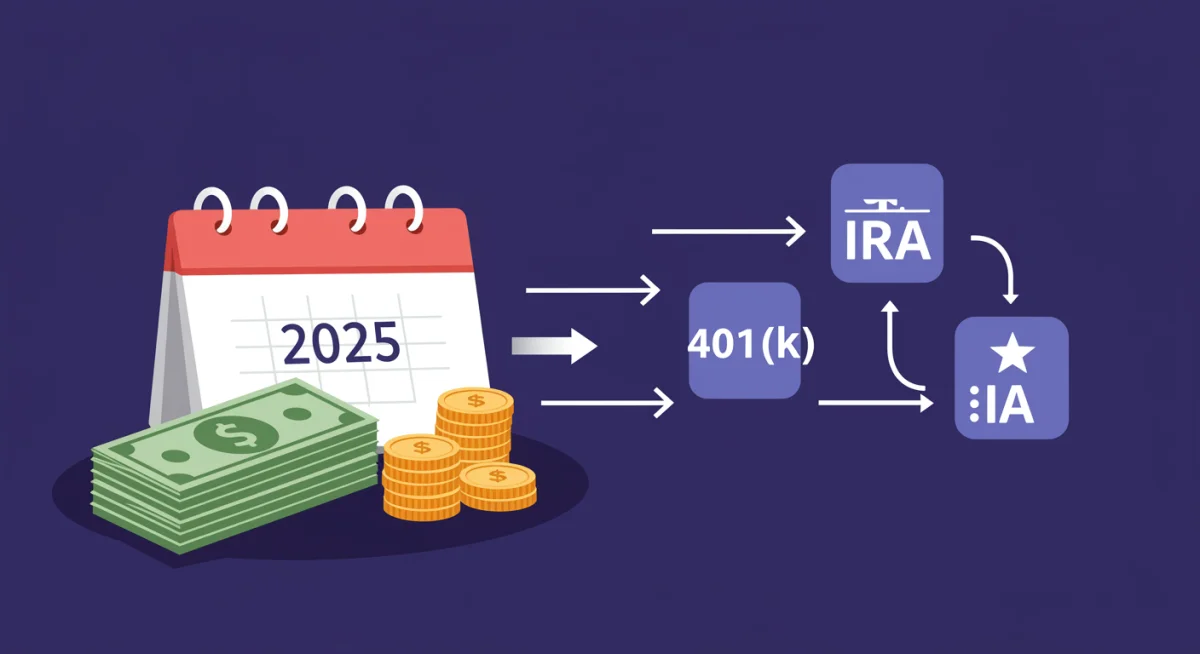
For 2025, the projected IRA contribution limit for most individuals is around $7,000. Similar to 401(k)s, those aged 50 and over can take advantage of a catch-up contribution, expected to be approximately $1,000, bringing their total potential contribution to $8,000. These limits apply to both traditional and Roth IRAs, though income limitations can affect your ability to contribute to a Roth IRA or deduct traditional IRA contributions.
It is critical to be aware of the Modified Adjusted Gross Income (MAGI) thresholds for Roth IRA contributions, as exceeding these limits can restrict or eliminate your ability to contribute directly. However, strategies like the ‘backdoor Roth IRA’ can still allow high-income earners to contribute indirectly.
- Standard Limit: Anticipate around $7,000 for most individuals.
- Catch-Up Limit (Age 50+): Expect an additional $1,000, totaling $8,000.
- Income Limitations: Be mindful of MAGI thresholds for Roth IRA contributions and traditional IRA deductibility if covered by a workplace plan.
By understanding and adhering to these limits, and exploring strategies for high-income earners, you can effectively use IRAs to bolster your retirement savings and optimize your tax position.
Unlocking the $7,000 Potential Gain: A Detailed Breakdown
The potential $7,000 gain from maximizing your 401(k) and IRA contributions in 2025 is not a hypothetical figure; it’s a tangible benefit derived from a combination of tax deductions, tax-free growth, and employer matches. This gain can significantly enhance your retirement security and overall financial well-being. Understanding how this figure is reached involves looking at various tax savings mechanisms.
Consider a scenario where you fully utilize all available avenues. The immediate tax deduction for traditional contributions, coupled with the long-term tax-free growth of Roth accounts, creates a powerful wealth-building engine. This section will break down how these elements combine to deliver substantial financial advantages.
Calculating Your Tax Savings and Growth
The $7,000 potential gain is a composite of several factors. For instance, if you contribute the maximum to a traditional 401(k) and IRA, and you are in a 24% federal tax bracket, the immediate tax deduction from these contributions could be substantial. For example, a $23,000 401(k) contribution could reduce your taxable income by that amount, saving you $5,520 in federal taxes (24% of $23,000). Add a $7,000 traditional IRA contribution, and that’s another $1,680 in tax savings (24% of $7,000), bringing the total to $7,200 in immediate tax savings. This doesn’t even account for state tax savings or the long-term, tax-deferred growth.
Moreover, if your employer offers a 401(k) match, contributing enough to secure that match is essentially a 100% return on that portion of your contribution. If your employer matches 50% up to 6% of your salary, and you earn $60,000, that’s $1,800 of free money annually. Over a career, this adds up to hundreds of thousands of dollars.
- Immediate Tax Reductions: Direct savings from deductible contributions to traditional accounts.
- Tax-Deferred Growth: Investments grow without being taxed annually until withdrawal.
- Tax-Free Withdrawals: For Roth accounts, qualified distributions in retirement are tax-free.
- Employer Matches: Free money that significantly boosts your savings.
By strategically combining these elements, individuals can realize substantial financial benefits, making the most of their proactive approach to retirement planning.
Strategic Planning and Contribution Methods
To effectively maximize your retirement savings tax benefits for 2025, strategic planning and consistent contribution methods are paramount. It’s not enough to simply know the limits; you need a plan to meet them. This involves budgeting, automating contributions, and regularly reviewing your financial situation to ensure you’re on track.
Many individuals find it challenging to contribute the maximum amount, especially early in their careers. However, even small, consistent increases can make a significant difference over time. The key is to start early and be disciplined.
Automating Your Contributions and Reviewing Annually
One of the most effective strategies for maximizing contributions is to automate them. Setting up automatic deductions from your paycheck for your 401(k) and recurring transfers for your IRA ensures that you consistently contribute without having to remember. This ‘set it and forget it’ approach helps overcome procrastination and ensures you hit your targets.
Furthermore, an annual financial review is crucial. As your income changes, so might your ability to contribute more. Reviewing your budget and contribution levels each year allows you to adjust and take advantage of any increased capacity to save. This is also an opportunity to re-evaluate your investment strategy within your retirement accounts.
- Automate: Set up automatic transfers to ensure consistent contributions.
- Budget: Create a financial plan that prioritizes retirement savings.
- Review: Annually assess your income, expenses, and contribution levels to make necessary adjustments.
- Adjust: Increase contributions as your income grows or expenses decrease.
By adopting these strategic planning and contribution methods, you can systematically work towards maximizing your retirement savings and fully capture the associated tax benefits.
Avoiding Common Pitfalls in Retirement Savings
While the path to maximizing retirement savings tax benefits seems straightforward, many individuals encounter common pitfalls that can derail their efforts. These include failing to contribute enough, making poor investment choices, not understanding tax implications, and succumbing to financial emergencies without proper planning. Awareness of these traps is the first step toward avoiding them and securing your financial future.
It’s important to remember that retirement planning is a marathon, not a sprint. Consistency and informed decision-making are far more valuable than sporadic, high-risk strategies.
Key Mistakes to Sidestep
One significant mistake is not taking advantage of employer matches. This is essentially leaving free money on the table, which can have a massive impact over decades. Another common error is not adjusting contributions as income increases. Many people set their contributions once and never revisit them, missing opportunities to save more.
Furthermore, neglecting to diversify investments within retirement accounts can expose you to unnecessary risk. While it’s tempting to chase high returns, a balanced portfolio that aligns with your risk tolerance and time horizon is generally a more prudent approach. Lastly, withdrawing funds prematurely from retirement accounts often incurs significant penalties and lost growth, severely undermining your long-term goals.
- Ignoring Employer Match: Always contribute enough to get the full match.
- Stagnant Contributions: Increase contributions as your income grows.
- Poor Investment Choices: Diversify your portfolio and align it with your risk tolerance.
- Early Withdrawals: Avoid taking money out of retirement accounts before age 59½, if possible.
By being mindful of these common pitfalls and actively working to avoid them, you can protect your retirement savings and ensure they grow as intended, securing your future financial independence.
Staying Informed on Tax Law Changes for 2025 and Beyond
The landscape of tax laws is dynamic, with changes occurring frequently that can impact your retirement savings tax benefits. For 2025 and subsequent years, it’s crucial to stay informed about any legislative updates from the IRS and Congress. These changes can include adjustments to contribution limits, income thresholds, and even the tax treatment of certain retirement accounts. Proactive awareness allows you to adapt your financial strategy as needed, ensuring you continue to maximize your savings.
Relying on outdated information can lead to missed opportunities or, worse, non-compliance with tax regulations. Therefore, making it a habit to check official sources and consult with financial professionals is a wise approach.
Resources for Timely Updates and Professional Guidance
To stay abreast of the latest tax law changes, regularly consult official IRS publications and announcements. Websites like IRS.gov are invaluable resources for the most accurate and up-to-date information. Financial news outlets and reputable personal finance blogs also provide excellent summaries and analyses of impending changes, often translating complex legal jargon into understandable terms.
For personalized advice, engaging with a qualified financial advisor or tax professional is highly recommended. These experts can help you navigate the complexities of tax law, understand how changes specifically affect your situation, and adjust your retirement planning strategy accordingly. Their expertise can be invaluable in optimizing your tax benefits and avoiding costly mistakes.
- IRS.gov: Your primary source for official tax law updates.
- Financial News: Reputable outlets often provide timely analysis.
- Tax Professionals: Consult CPAs or tax attorneys for specific guidance.
- Financial Advisors: Get personalized recommendations for your retirement strategy.
By actively seeking out and utilizing these resources, you can ensure your retirement savings strategy remains compliant, efficient, and maximally beneficial in the face of evolving tax laws.
| Key Point | Brief Description |
|---|---|
| Maximize 401(k) Contributions | Contribute up to projected $23,000 ($30,500 for age 50+) to reduce taxable income and secure employer matches. |
| Utilize IRA Contributions | Add up to projected $7,000 ($8,000 for age 50+) to traditional or Roth IRAs for additional tax advantages. |
| Potential $7,000 Gain | Achieve significant tax savings and growth through combined 401(k) and IRA maximization, plus employer matches. |
| Stay Informed | Regularly check IRS updates and consult financial professionals to adapt to changing tax laws. |
Frequently asked questions about retirement savings tax benefits
For 2025, the standard 401(k) contribution limit is projected to be around $23,000. For individuals aged 50 and over, an additional catch-up contribution of approximately $7,500 is expected, bringing their total to $30,500. These figures are subject to final IRS adjustments, so it’s always wise to confirm with official sources.
The projected IRA contribution limit for 2025 is around $7,000. If you are 50 or older, you can make an additional catch-up contribution of approximately $1,000, totaling $8,000. Income limitations may apply, especially for Roth IRAs and the deductibility of traditional IRA contributions if you’re covered by a workplace plan.
The ‘backdoor Roth IRA’ is a strategy for high-income earners who exceed the direct Roth IRA contribution limits. It involves contributing after-tax money to a traditional IRA and then immediately converting it to a Roth IRA. This allows individuals to benefit from tax-free growth and withdrawals in retirement, bypassing income restrictions.
An employer 401(k) match is essentially free money contributed by your employer to your retirement account, based on your own contributions. It’s a guaranteed return on investment, significantly boosting your savings without additional effort on your part. Always contribute at least enough to receive the full employer match.
Tax laws, including those related to retirement savings, are subject to change by the IRS and Congress. Staying informed ensures you can adjust your financial strategy to continue maximizing tax benefits, avoid penalties, and optimize your retirement planning in accordance with the latest regulations. Official IRS resources are key for this.
Conclusion
Maximizing your 401(k) and IRA contributions for 2025 is a powerful strategy to enhance your retirement security and unlock substantial retirement savings tax benefits. By understanding the projected contribution limits, differentiating between traditional and Roth accounts, and diligently planning your contributions, you can potentially realize gains of $7,000 or more. Avoiding common pitfalls and staying informed about evolving tax laws are equally crucial steps in this journey. Proactive engagement with your retirement planning, coupled with professional guidance, ensures that you are well-positioned for a financially secure future.